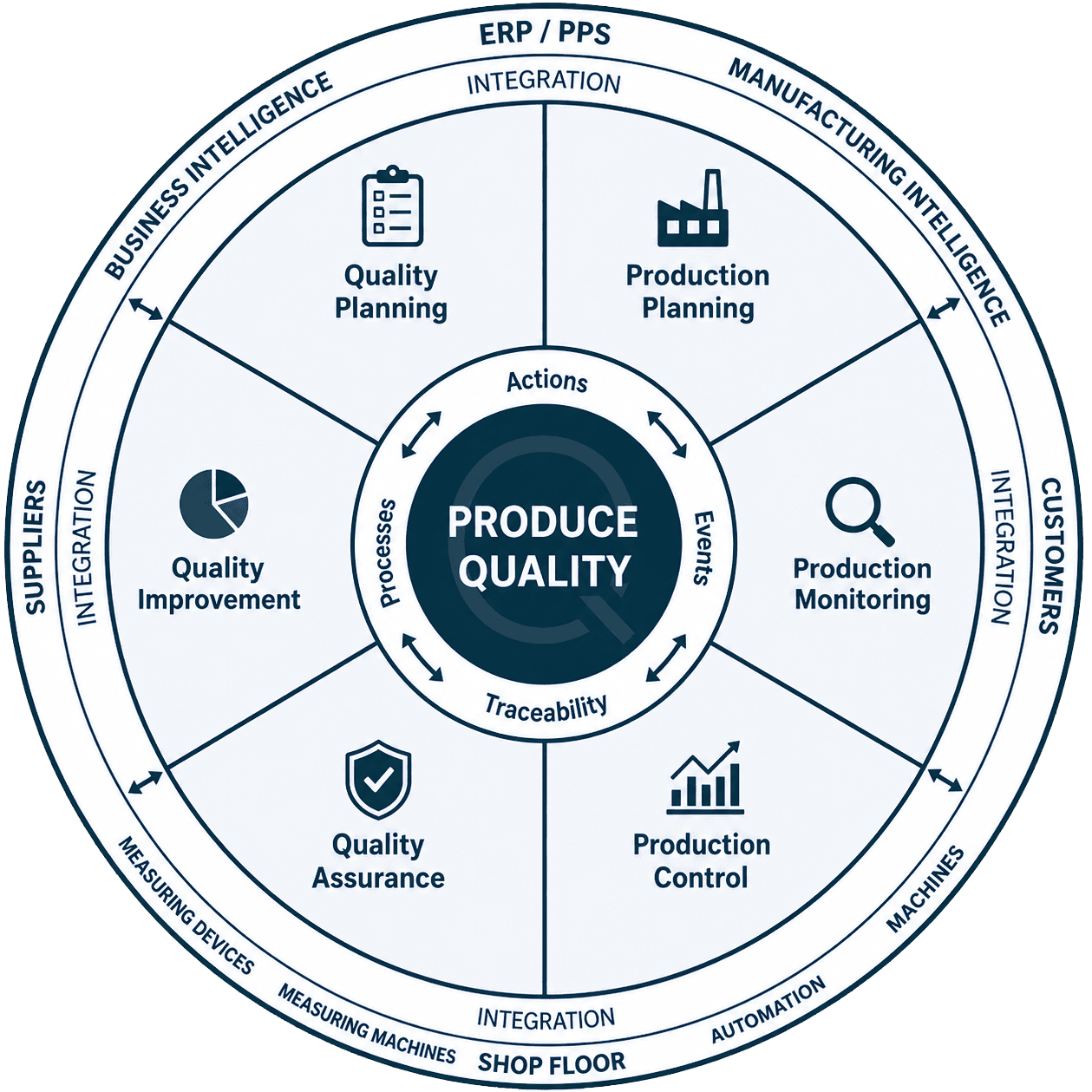
Quality Management
Quality management (QM) is the systematic approach to planning, controlling, assuring and continually improving the quality of products, services and processes across an organization.
Quality management refers to the comprehensive set of coordinated organizational, structural and methodological measures used to systematically plan, control, assure and continually improve the quality of products, services and processes. It is not a single tool, but an overarching management concept that understands quality as a systemic characteristic of an organization.
Systemic Classification of Quality Management
Quality management provides the central framework for all quality-related activities within organizations. It integrates elements of quality assurance, quality planning, quality control and continual improvement into a coherent overall system.
As a management approach, quality management is closely linked to normative reference frameworks such as ISO 9001, without being limited to their requirements. The standard defines minimum requirements for a quality management system, whereas quality management as a concept goes beyond these requirements.
Objectives and Fundamental Logic
The objective of quality management is an organization’s sustainable ability to reliably meet defined requirements and systematically develop them further. Quality is not understood as the result of individual inspections, but as the outcome of controlled processes and clearly defined responsibilities.
The fundamental system logic of quality management is based on:
- process-oriented management
- evidence-based decision-making
- risk-based thinking
- continual improvement
Quality Management as a Management System
A quality management system (QMS) describes the structured implementation of quality management within an organization. It includes organizational rules, documented processes, responsibilities and methods for monitoring and evaluating process performance.
The QMS ensures that quality management is not carried out situationally, but systematically, reproducibly and in a verifiable manner.
Levels of Impact of Quality Management
As a master concept, quality management has an impact on several levels:
- Organization: Establishing clear structures, roles and control loops
- Leadership: Embedding quality as a leadership and management responsibility
- Processes: Defining, monitoring and improving value-adding processes
- Culture: Developing a shared understanding of quality
Strategic, Tactical and Operational Classification
Quality management operates across different planning levels:
- Strategic: Defining the quality direction, for example through quality policy and quality objectives
- Tactical: Designing processes, KPI systems and methods
- Operational: Applying quality-related procedures in day-to-day operations
These levels are systemically interconnected and should not be considered in isolation.
Distinction from Quality Assurance and Quality Control
Quality management must be clearly distinguished from subordinate disciplines. Quality assurance is part of quality management and focuses on the operational implementation of quality-related measures. Quality control describes inspection and verification activities, but does not constitute a management approach.
Quality management integrates these elements, but does not replace them.
The Role of Methods and Tools
Methods such as FMEA or Statistical Process Control support quality management in specific areas. However, they should not be equated with quality management itself, but serve its operational implementation.
Normative Classification
ISO 9001 provides the central normative reference framework for quality management systems. Additional standards may complement it, but they do not change the fundamental system logic of quality management. No normative implementation instructions are derived from the standard.
FAQ – Frequently Asked Questions About Quality Management
What is quality management?
Quality management is the systematic planning, control and improvement of quality-related organizational and process structures.
Is quality management the same as ISO 9001?
No. ISO 9001 is a standard for quality management systems, whereas quality management describes the overarching management concept.
What role does leadership play in quality management?
Leadership is central because quality must be understood as a leadership responsibility and embedded systemically.
Is quality management only relevant for industry?
No. Quality management is industry-independent and can be applied to organizations of any type.
Does quality management replace inspections?
No. Inspections are part of quality assurance and are systemically embedded through quality management.
Related Internal Content
- Quality Policy as a Strategic Element
- Processes in Quality Management
- Statistical Process Control (SPC)
CAQ that produces quality
From inspection planning to operator guidance – modular, integrable, and SAP-compatible
- Significantly reduced inspection effort through CTQ and adaptive inspection strategies
- Zero-defect approach through inline inspection and machine integration
- End-to-end SAP integration and shopfloor connectivity
More than 45 years in manufacturing