

QM.CAQ
Implement quality within the process
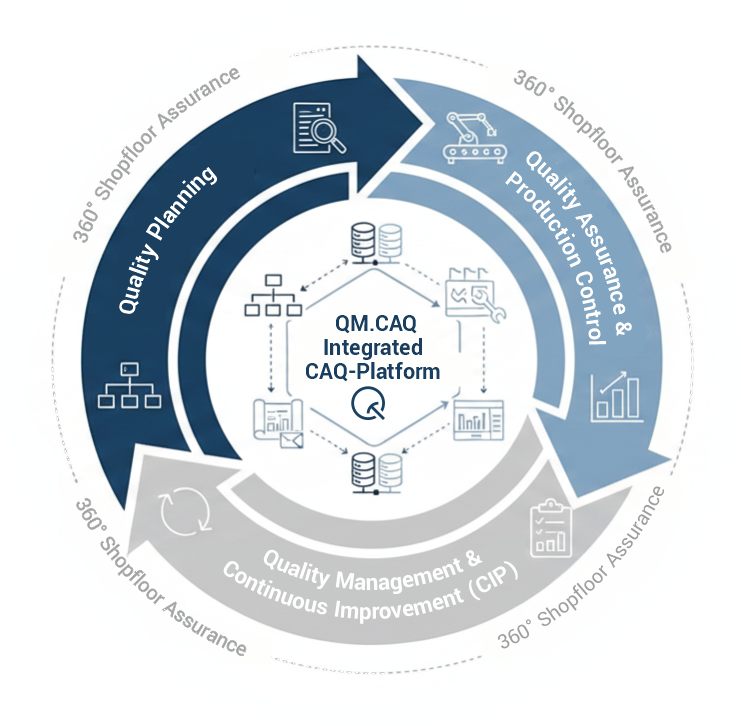
QM.CAQ is our software platform that brings together quality planning, quality assurance, production data, and quality management (continuous improvement) within a comprehensive, modular, and integrable CAQ system.
What it’s about
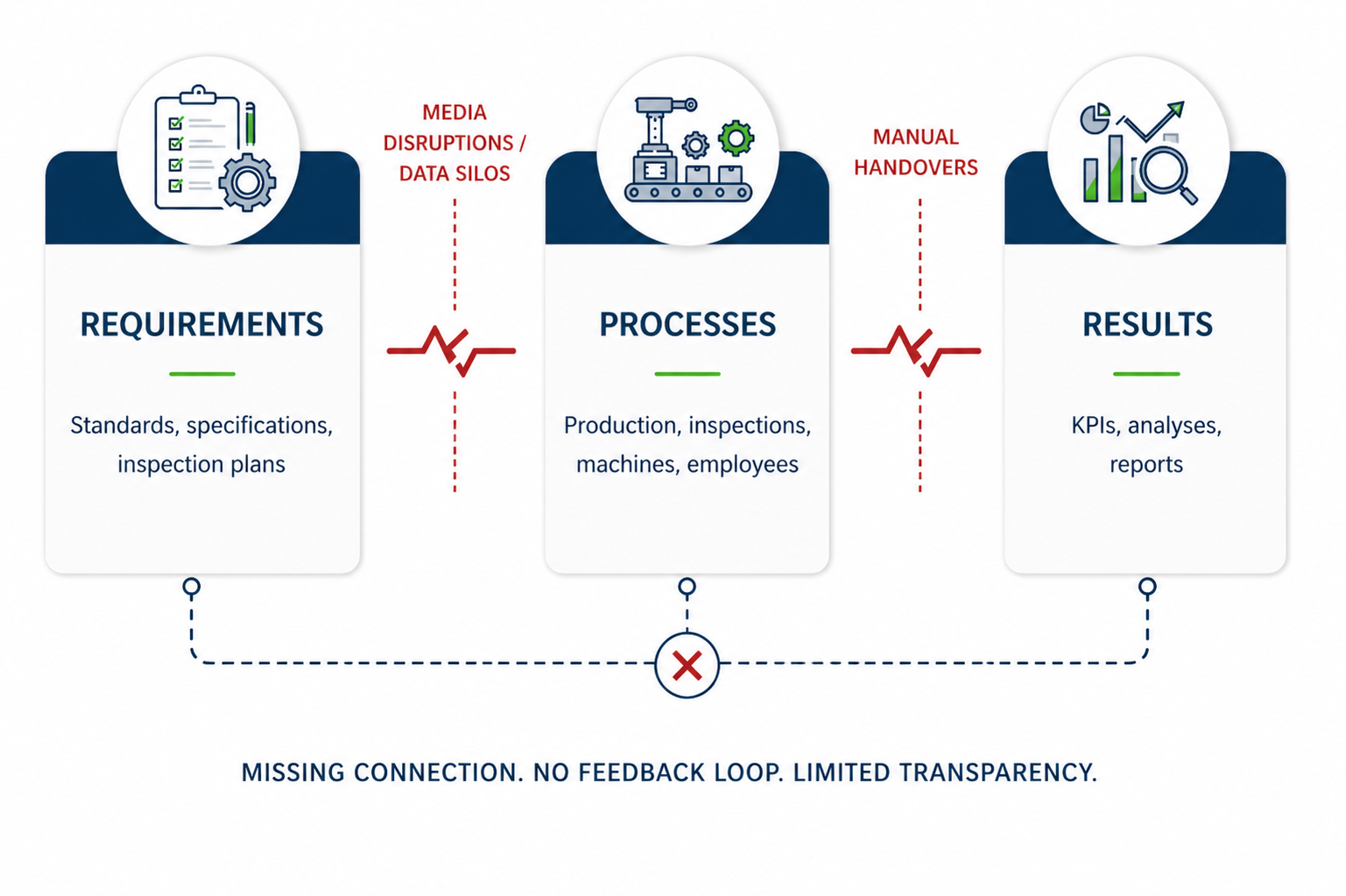
In many companies, there are gaps between planning, production, and analysis.
Requirements are defined, processes are running, and results are captured—yet the end-to-end connection between these layers is often missing.
What makes QM.CAQ different
Philosophy and approach
QM.CAQ translates requirements into the operational process. Measurements and inspections are performed in the context of these requirements. Results are evaluated immediately and directly linked to the process. This creates an end-to-end connection between planning, execution, and improvement—forming the basis for digital process assurance.
Impact
The difference becomes visible in daily operations:
- Deviations become visible in time.
- Evaluations are made in the context of the process.
- Actions intervene directly in the workflow.
Processes become more stable through continuous feedback.
Integration into production
QM.CAQ works close to the process—ideally within the process itself. Machine, process, and quality data are viewed and evaluated together. Quality and production become one functional unit for producing quality.
Modules / Functions
QM.CAQ is a modular platform that seamlessly integrates into existing ERP and system landscapes, enabling end-to-end quality management within manufacturing.
Quality Planning
Structured methods for ensuring product and process quality.


Quality Assurance & Production Control
Structured methods to ensure quality in manufacturing and enable transparent control of production processes.


Quality Management & Continuous Improvement (CI)
Structured methods to ensure quality, transparency, and continuous improvement.


APPLICATION
QM.CAQ is used across organizations of all sizes—from mid-sized companies to global enterprises. Many requirements are already covered within the standard system based on practical experience. Additional processes, systems, and requirements can be specifically connected and integrated.

Principle
As much standardization as possible, as much customization as necessary.
Compact expert knowledge for informed QM decisions
Free e-papers & product datasheets for quality management decision-makers
In a no-obligation conversation, we explore how Quality Mining and modular CAQ software can be applied in your production—practical, integrated, and without commitment.
We listen, understand your goals and challenges, and bring over 45 years of experience in quality management and process effectiveness.
Direkt mit Fachberater
Frequently Asked Questions about CAQ Software
What are the benefits of customizable CAQ software?
In manufacturing, a significant part of company-specific know-how lies within the process. Production workflows, inspection strategies, and quality requirements therefore vary considerably from one company to another.
Customizable CAQ software makes it possible to systematically map these specific conditions without changing the underlying quality logic.
While the mechanisms of quality planning, quality assurance, and continuous improvement can be standardized, their implementation must be adapted to the respective process.
The advantage lies in combining:
- consistent, transferable quality logic
- individual mapping of real manufacturing processes
This ensures that quality is not only documented, but effectively embedded within the process.
How do you integrate existing systems such as SAP, ERP, or MES?
Existing systems are not replaced but functionally extended.
Structural data such as master data, inspection lots, or orders remain in leading systems like SAP or ERP. The CAQ software handles process-related execution, particularly data capture, inspection, and feedback.
Data exchange takes place via defined interfaces, with the goal of a consistent data base without media disruptions or redundant maintenance.
Existing Excel-based solutions are not simply transferred but transformed into a structured and scalable system logic that enables end-to-end process integration.
How can I adapt CAQ software to my specific requirements?
Existing systems are not replaced but functionally extended.
Structural data such as master data, inspection lots, or orders remain in leading systems like SAP or ERP. The CAQ software handles process-related execution, particularly data capture, inspection, and feedback.
Data exchange takes place via defined interfaces, with the goal of a consistent data base without media disruptions or redundant maintenance.
Existing Excel-based solutions are not simply transferred but transformed into a structured and scalable system logic that enables end-to-end process integration.
What should I consider when selecting customizable CAQ software?
Selecting CAQ software is a multi-step process that strongly depends on the company’s initial situation.
A clear understanding of existing processes and inspection strategies is essential.
Unclear workflows or inconsistent structures increase implementation effort and make later use more difficult.
Key criteria include:
- Ability to map quality planning, inspection, and analysis end-to-end
- Integration of control plans, inspection plans, and quality-critical characteristics into operational processes
- Capability for automated data capture and clear assignment of measurement data
- Integration of inspection equipment and machines (e.g., via interfaces or import mechanisms)
- Seamless integration into existing system landscapes (ERP, MES, specialized applications)
- Modular structure for step-by-step implementation and expansion
The goal is a solution that can accommodate changes in processes, inspection strategies, and data sources without destabilizing the existing structure.

Your personal contacts
Let’s talk.
Our experts will advise you personally—without obligation and on equal terms.


