Statistical Process Control (SPC)
Statistical process control (SPC) is a quality management method for monitoring, analyzing and evaluating processes objectively based on statistical indicators. Its aim is to distinguish clearly between random process variation and systematic deviations so that process stability can be evaluated over time. SPC is not an inspection method; it is an analytical tool for controlling and monitoring within process-oriented quality management systems.
SPC in Quality Management
In functional terms, SPC sits between quality management, quality assurance and process-oriented control. The method is used to evaluate process behavior based on data and complements structural elements such as process definitions, control loops and quality objectives.
Within a quality management system based on ISO 9001, SPC supports the requirement to monitor, measure, analyze and evaluate processes, without defining any normative requirements itself.
The Basic Principle of Statistical Process Control
At the core of SPC is the statistical description of process characteristics over time. Continuous data collection and evaluation make the course of a process visible. The evaluation is based on statistical parameters such as measures of location and dispersion as well as defined control and warning limits.
Statistical process control is based on the assumption that every process has inherent variation. SPC distinguishes between:
- random variation inherent in the system
- special, identifiable causes with a structural influence
SPC vs. Inspection and Quality Control
SPC is not the same as conventional final inspection or incoming inspection. While inspections evaluate results, SPC analyzes process behavior. The method does not aim to sort out defective units but to evaluate process stability and process control statistically.
SPC is therefore clearly different from reactive quality assurance measures and is a preventive analytical tool.
SPC and Process Capability
A stable process that is in statistical control is a prerequisite for evaluating process capability. SPC provides the analysis of stability over time, while process capability indices describe the location and spread of the process in relation to the specification limits.
The two concepts are closely linked, but they need to be clearly distinguished.
The Role of SPC in Manufacturing
In manufacturing, SPC is used in particular for repeatable, measurable processes. Typical applications are series production processes with high quality requirements and tight tolerances.
SPC has an impact at several levels:
- Organization: establishing data-based process evaluation
- Management: making process decisions more objective
- Processes: transparency about stability and variation
- Culture: promoting an analytical understanding of quality
SPC vs. Standards, Methods and Software
SPC is a statistical method. It is neither a standard nor a software solution. Standards such as ISO 9001 define general requirements, while software solutions only provide technical support for SPC functions. The methodology of SPC is independent of the IT systems used.
FAQ – Frequently Asked Questions About Statistical Process Control
What is the main objective of SPC?
The objective of SPC is to evaluate process stability statistically over time in order to distinguish random variation from systematic deviations.
Is SPC an inspection method?
No. SPC is an analytical method for monitoring and evaluating processes and does not replace inspection or control processes.
What role does SPC play in the quality management system?
SPC supports the data-based monitoring and analysis of processes and complements the requirements for measurement and evaluation under ISO 9001.
How does SPC differ from process capability?
SPC evaluates the stability of a process over time, while process capability describes the statistical ability of a stable process to meet the specification limits.
Is SPC possible without software?
The method is fundamentally independent of software. IT systems are used only for data collection, evaluation and visualization.
Standards and Norms
ISO 9001 provides the overarching framework for the use of SPC. In industries with specific requirements, such as the automotive industry, SPC is closely linked to IATF 16949, without being a standard itself.
Further Internal Content
- Process capability in quality management
- The control plan as a structuring element of quality
- SPC in CAQ software
AI-assisted · Editing and publication: Christian Sedlag · Last updated: 9 November 2026
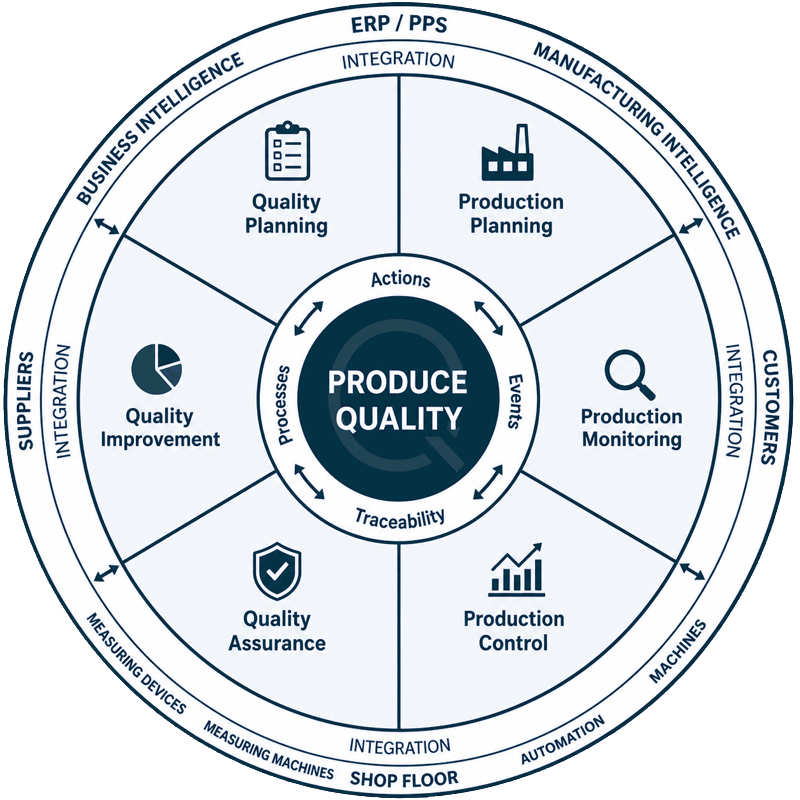
CAQ that produces quality
From inspection planning to operator guidance – modular, integrable, and SAP-compatible
- Significantly reduced inspection effort through CTQ and adaptive inspection strategies
- Zero-defect approach through inline inspection and machine integration
- End-to-end SAP integration and shopfloor connectivity
More than 45 years in manufacturing