Document Control
Document control is the systematic management, monitoring and control of documented information within a quality management system. It ensures that relevant documents can be clearly identified, are up to date and available and are protected against unintended use. Document control is not an end in itself; it ensures that quality-related information is reliable, traceable and consistent.
Document Control in Quality Management
Document control is a basic structural element of quality management and has a direct effect within quality assurance. It provides the formal basis for processes, rules and requirements to be understood and applied consistently.
In quality management systems based on ISO 9001, the control of documented information is a central element for ensuring effectiveness, transparency and the ability to provide evidence.
Objectives and Basic Principles of Document Control
The objective of document control is to ensure that documents are correct, up to date and available in a controlled way. Documents should be available exactly where they are needed and should only be used in the currently approved version.
Document control is based on:
- clear identification of documents
- clearly defined creation, review and approval
- controlled changes and versioning
- protection against the unintended use of invalid information
Documented Information in Quality Management
Document control applies to all documented information relevant to quality management. This includes, among other things:
- process descriptions and procedures
- work and inspection instructions
- forms, templates and checklists
- quality-related rules and specifications
Document control does not distinguish between documents by content but by the function and intended use of the information.
Documents vs. Records
Documents and records need to be distinguished. Documents describe target states, rules or procedures. Records, on the other hand, document actual states or the results of activities performed.
Document control primarily covers documents, while records are also controlled and retained but are subject to different rules.
The Role of Document Control in Manufacturing
Document control is particularly important in manufacturing because quality-related information is often used close to the process, across shifts and across sites. Uncontrolled or outdated documents can lead directly to process deviations or quality risks, for example if inspection instructions for statistical process control are not up to date.
The effects of document control can be seen at several levels:
- Organization: consistent and traceable rules
- Management: a reliable basis for control and accountability
- Processes: consistent application of defined procedures
- Culture: awareness that documented requirements are binding
Document Control vs. Methods, Standards and Software
Document control is a management and organizational process. It is neither a method for quality improvement nor a standard. Software solutions support document control technically, but they do not define its underlying principles.
Responsibility for content, currency and approvals remains with the organization, regardless of the IT systems used.
FAQ – Frequently Asked Questions About Document Control
What is document control?
Document control is the systematic management and monitoring of quality-related documents in terms of currency, availability and validity.
Is document control the same as document management?
No. Document management covers organizational and technical aspects, while document control describes the quality-related framework of rules.
Why does document control matter for quality?
Because only current and approved documents allow processes to be carried out consistently and in compliance with the rules.
Is document control required by standards?
ISO 9001 requires documented information to be controlled, but it does not prescribe how this is to be implemented.
Does document control depend on software?
No. Document control is independent of software; IT systems only support its implementation.
Standards and Norms
ISO 9001 requires the control of documented information as an integral part of the quality management system. The standard does not prescribe how this is to be done; it describes the functional requirements for availability, protection, currency and traceability.
Further Internal Content
AI-assisted · Editing and publication: Christian Sedlag · Last updated: 9 November 2026
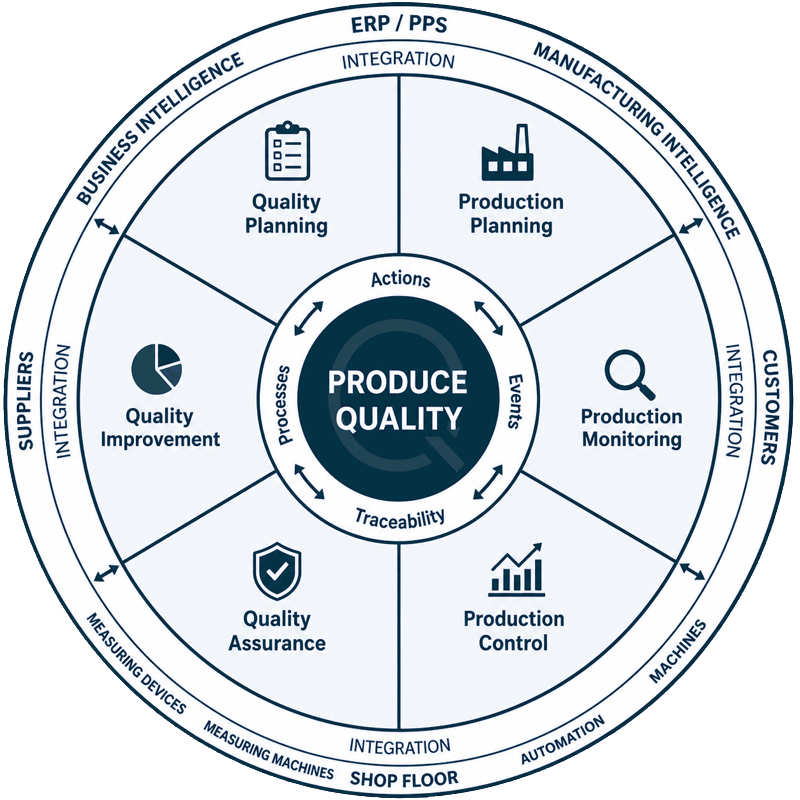
CAQ that produces quality
From inspection planning to operator guidance – modular, integrable, and SAP-compatible
- Significantly reduced inspection effort through CTQ and adaptive inspection strategies
- Zero-defect approach through inline inspection and machine integration
- End-to-end SAP integration and shopfloor connectivity
More than 45 years in manufacturing