Initial Sample Inspection Report (ISIR)
The initial sample inspection report (ISIR) is a formal document for the complete and traceable verification of a product before series release. It provides evidence that a part or assembly was manufactured under production-representative conditions and meets all specified requirements.
In quality management, the initial sample inspection report is a central instrument of preventive quality assurance. It links development, planning and production processes and documents the technical conformity of a product with the drawing, the specification and the contractual agreement.
Role in the Product Development Process
The initial sample inspection report is typically part of structured product development processes such as APQP. It marks the transition from the development and sampling phases to series production.
From a system perspective, the ISIR serves the following purposes:
- evidence of conformity with technical specifications,
- validation of manufacturing processes under series conditions,
- basis for release by customers or internal committees,
- documentation for traceability and audit evidence.
What Does an Initial Sample Inspection Report Contain?
The exact format can vary by industry, customer requirement or standard. Typically, however, an initial sample inspection report includes the following elements:
Identification Data
- part number and revision level
- drawing reference
- manufacturer and plant information
- production date and lot identification
Characteristic-Based Inspections
All specified product characteristics, whether geometric, functional, material-related or surface-related, are fully inspected and documented. The results are compared with the nominal values.
Process-Related Evidence
- manufacturing and inspection plan (for example, a control plan)
- risk analyses (for example, an FMEA)
- process capability evidence
- material certificates and material test certificates
Release Decision
Final evaluation and release or rejection by the customer or the responsible organizational unit.
ISIR vs. Series Inspections
The initial sample inspection report differs fundamentally from ongoing series inspections. Series inspections are used to monitor processes continuously, for example through statistical process control, whereas the ISIR is an initial, complete verification before the start of series production.
It is therefore not a continuous monitoring tool but a formal release record in the product development process.
Industry-Specific Requirements
In the automotive industry, the initial sample inspection report is closely linked to the requirements of IATF 16949. Internationally, the Production Part Approval Process (PPAP) is often used in this context.
In other industries, customer-specific rules or normative requirements may define additional content or formats. The basic objective remains the same: documented evidence of conformity before series release.
Importance for Audit Readiness and Traceability
The initial sample inspection report is a key reference in internal and external audits. It documents:
- consistency between development and production,
- the effectiveness of process planning,
- the traceability of inspection decisions,
- audit-proof documentation of product characteristics.
It therefore supports the requirements for documented information under ISO 9001.
Digitalization and System Integration
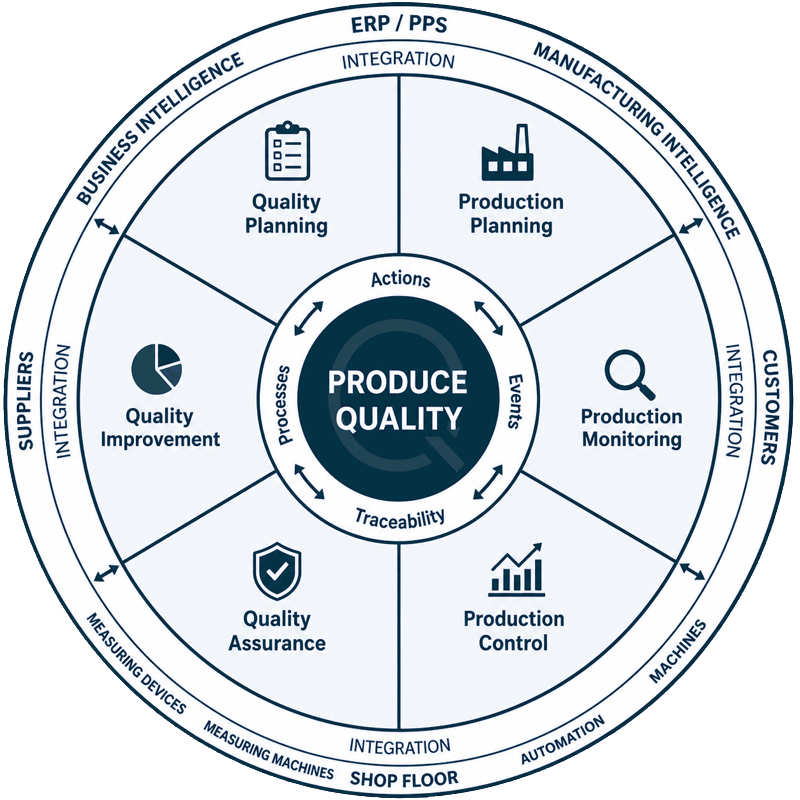
In digital quality environments, the initial sample inspection report is often integrated into CAQ systems, where inspection characteristics, drawing revisions, measurement data and release processes are linked in a structured way.
System support enables:
- consistent data throughout,
- automated transfer of inspection characteristics from CAD or ERP systems,
- central archiving and versioning,
- transparency across sites in multi-plant structures.
FAQ
What is an initial sample inspection report?
An initial sample inspection report is documented evidence that a product was manufactured under production-representative conditions and meets all specified requirements.
When is an initial sample inspection report created?
It is created before series release, typically after product changes, new tooling, a change of production site or when a part is manufactured for the first time.
Is the initial sample inspection report an ongoing series inspection?
No. It is a one-time, complete verification as part of product and process approval, not a continuous monitoring tool.
Which standards are related to the initial sample inspection report?
The initial sample inspection report relates to ISO 9001 and, in the automotive industry, to IATF 16949 and associated approval procedures such as PPAP.
Standards and Norms
- ISO 9001 – Quality management systems
- IATF 16949 – Quality management in the automotive industry
- Quality management
- Quality assurance
- Statistical process control
- Production Part Approval Process (PPAP)
Further Internal Content
- Initial sampling module in the CAQ system – the system context for digital sampling processes
AI-assisted · Editing and publication: Christian Sedlag · Last updated: 9 November 2026
CAQ that produces quality
From inspection planning to operator guidance – modular, integrable, and SAP-compatible
- Significantly reduced inspection effort through CTQ and adaptive inspection strategies
- Zero-defect approach through inline inspection and machine integration
- End-to-end SAP integration and shopfloor connectivity
More than 45 years in manufacturing