Control Plan
The Control Plan is a formalized document used for the systematic control of quality-relevant product and process characteristics within manufacturing operations. It defines which product and process characteristics must be monitored, which inspection or measurement methods are applied, how frequently inspections are performed, and which reaction plans are triggered in the event of deviations.
The Control Plan serves as an operational control instrument within quality management and quality assurance. It represents a central interface between advanced quality planning and serial production.
Systemic Classification Within Quality Management
Within a quality management system according to ISO 9001, the Control Plan specifies requirements related to process control and monitoring of production and service processes. It operationalizes planning-related requirements into binding inspection and monitoring mechanisms at the operational level.
Within a process-oriented system logic, the Control Plan defines:
- the translation of customer requirements into measurable characteristics,
- the assignment of inspection methods to process steps,
- the definition of responsibilities,
- the linkage between monitoring and reaction mechanisms.
The Control Plan therefore represents the structured implementation of process-related quality control in the context of Statistical Process Control (SPC) and related monitoring and control mechanisms.
Terminological Distinction
The Control Plan is neither a standard nor a standalone methodology, but a documented operational control instrument. It differs from:
- FMEA as a preventive risk analysis method,
- APQP as a structured advanced quality planning process,
- Statistical Process Control (SPC) as a methodological monitoring approach.
While FMEA identifies and evaluates potential failure causes, the Control Plan documents the resulting operational monitoring measures used in serial production. APQP defines the overarching project and maturity process, whereas the Control Plan operationalizes its results during production.
Structure and Typical Content
A Control Plan is process-oriented and follows the logical sequence of manufacturing operations. Typical structural elements include:
- process step or operation,
- product and process characteristics (critical, significant, or special characteristics),
- inspection and measurement equipment,
- inspection method and sample size,
- inspection frequency,
- reaction plan in case of deviations,
- responsibilities.
The reaction plan is an integral part of the system logic. It defines which actions must be initiated when specifications are not fulfilled and establishes the connection to operational process control and action management.
Lifecycle and Change Logic
The Control Plan is not a static document. It is continuously updated throughout the product and process lifecycle. Changes may be triggered by:
- findings from internal or external complaints,
- process modifications,
- changes in specifications,
- results from audits or process capability analyses,
- findings related to process capability.
The change logic follows the fundamental principle of documented control of quality-relevant information within the quality management system.
Normative and Industry-Specific Classification
In the automotive industry, the Control Plan is a mandatory element of advanced quality planning and is required within the framework of IATF 16949. It is directly linked to APQP, FMEA, and production approval processes.
Outside the automotive industry, documented process control is likewise a central requirement within standards such as ISO 9001. The Control Plan represents a structured implementation of requirements related to process monitoring, measurement, and operational control.
Distinction Between Control Plan, Inspection Plan, and Work Instructions
The Control Plan differs from a traditional inspection plan. While inspection plans primarily define inspection characteristics and inspection methods, the Control Plan additionally integrates process parameters, reaction mechanisms, and responsibilities across the entire process chain.
Unlike work instructions, which describe how a specific task is performed, the Control Plan defines the quality-relevant monitoring and control mechanisms associated with that process step.
Digitalization and System Integration
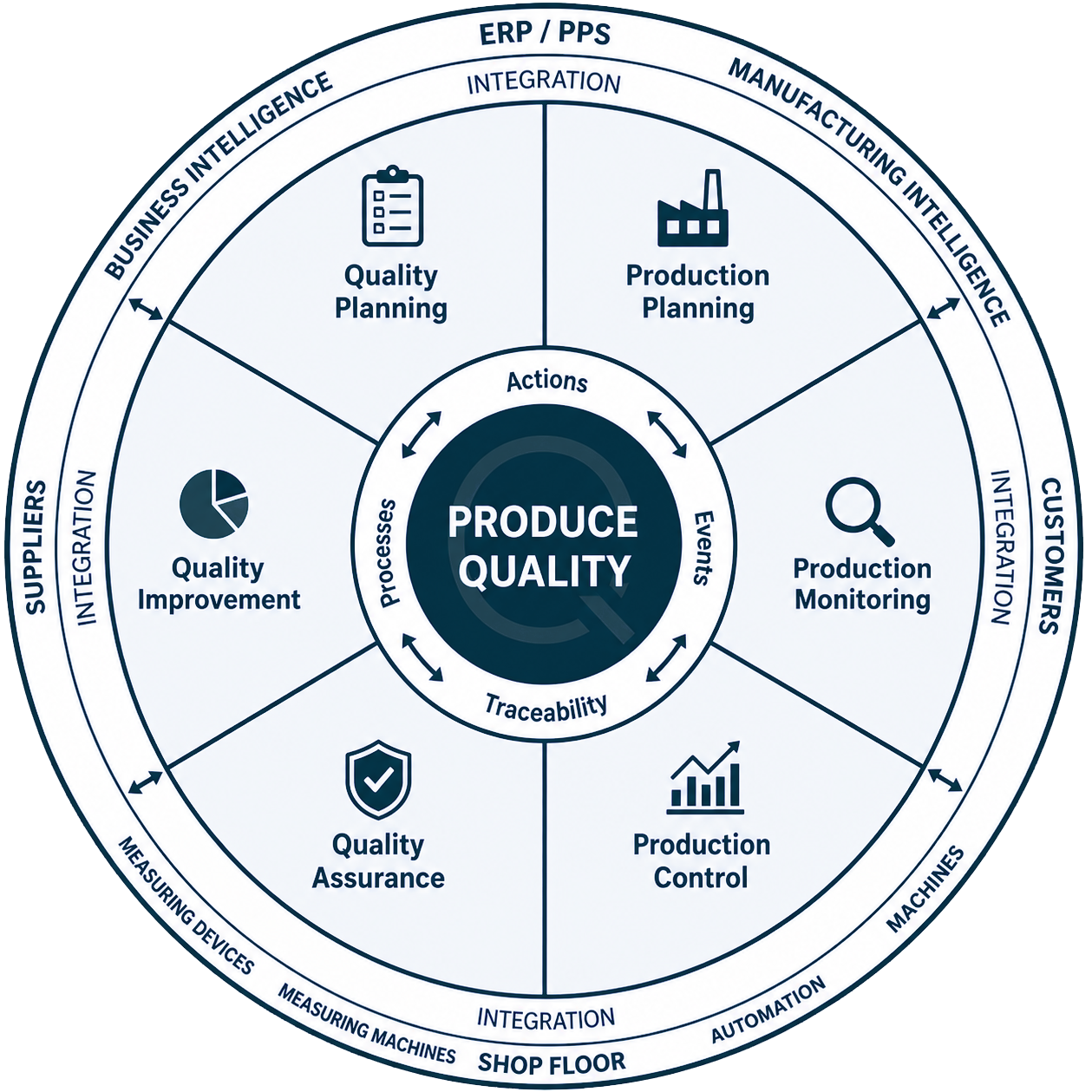
In digital manufacturing environments, the Control Plan is often integrated into CAQ systems. There, it is systematically linked with inspection plans, measurement data acquisition, statistical evaluations, and escalation mechanisms.
Digital integration enables a consistent data basis between planning, monitoring, and evaluation without changing the fundamental system logic of the Control Plan.
FAQ About the Control Plan
What is the main purpose of a Control Plan?
The primary purpose of a Control Plan is the structured assurance of process and product quality through defined monitoring, inspection, and reaction mechanisms throughout the entire manufacturing process.
How does the Control Plan differ from FMEA?
FMEA analyzes potential failures and evaluates risks preventively. The Control Plan documents the resulting operational monitoring measures for serial production.
Is a Control Plan mandatory according to ISO 9001?
ISO 9001 requires effective process control and monitoring but does not explicitly mandate a document called “Control Plan.” The Control Plan is considered a structured implementation of these requirements.
What role does the Control Plan play in IATF 16949?
Within IATF 16949, the Control Plan is a mandatory element of advanced quality planning and production assurance in the automotive industry.
CAQ that produces quality
From inspection planning to operator guidance – modular, integrable, and SAP-compatible
- Significantly reduced inspection effort through CTQ and adaptive inspection strategies
- Zero-defect approach through inline inspection and machine integration
- End-to-end SAP integration and shopfloor connectivity
More than 45 years in manufacturing