Incoming Goods
In an industrial context, incoming goods refers to the organizational and physical process of receiving, identifying, inspecting and releasing externally sourced materials, components or products. It is a key interface between the supplier and the company’s own value creation and an essential element of quality management and quality assurance.
Within a quality management system based on ISO 9001, the incoming goods process puts into practice the requirements for controlling externally provided processes, products and services. It is the first quality-related control point within the organization and has a major influence on the stability of downstream production processes.
Incoming Goods in the Production and Quality Context
Incoming goods are part of the upstream process chain and have an effect at several levels:
- Logistics: receiving, identifying, booking and forwarding materials.
- Quality: checking conformity with specifications and order requirements.
- Documentation: ensuring traceability and evidence.
Incoming goods act as a filter. Defective or nonconforming deliveries are identified before they reach production. This supports process stability and reduces the risk of internal failure costs.
Incoming Inspection
Incoming inspection is the quality assurance part of the incoming goods process. It includes checking:
- the identity and completeness of the delivery,
- documentation (e.g. inspection certificates, declarations of conformity),
- dimensional, functional or material characteristics,
- the condition of packaging and transport.
Depending on the risk classification, the supplier evaluation and how critical the product is, the inspection can be carried out as a 100% inspection, on a sampling basis or based on risk. Methods of statistical process control can be used to determine sample sizes and inspection intensity.
Risk-Based Control
Modern quality management systems follow a risk-based approach. The inspection intensity for incoming goods is determined based on factors such as:
- supplier performance,
- defect history,
- the supplier’s process capability,
- how critical the component is.
The aim is a balanced relationship between inspection reliability and cost.
Incoming Goods vs. Downstream Inspection Processes
Incoming goods differ from:
- In-process inspections: these are carried out during the company’s own manufacturing steps.
- Outgoing goods inspections: these ensure conformity before delivery to the customer.
While in-process and final inspections monitor internal manufacturing performance, incoming inspection evaluates the performance of external suppliers.
Digitalization and CAQ Integration
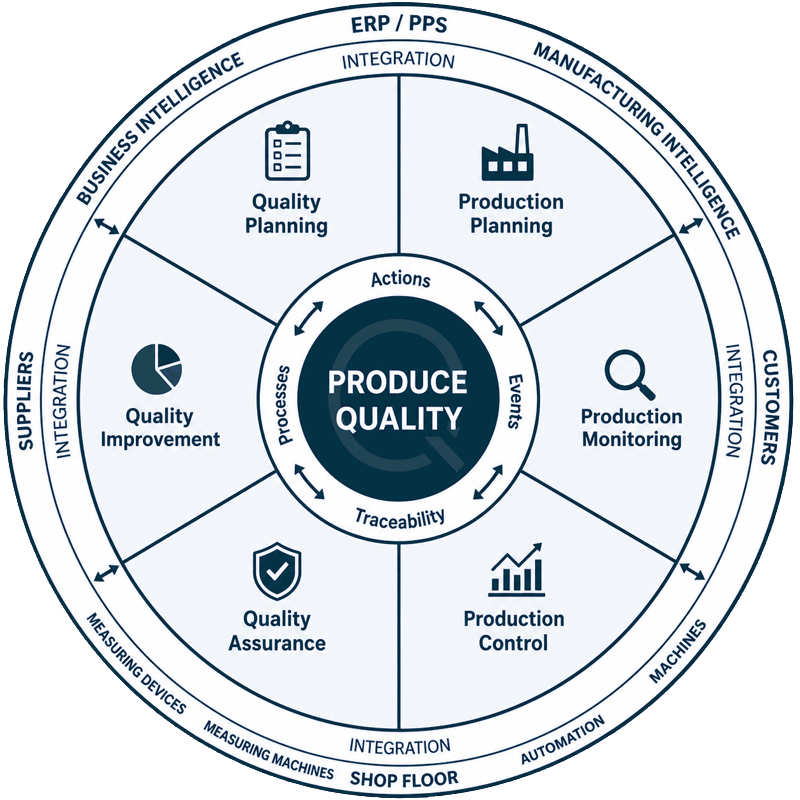
In digitally integrated production environments, incoming goods are often integrated into CAQ and ERP systems. Managing inspection plans, inspection characteristics and inspection data in the system enables consistent documentation and a direct link to supplier evaluations and complaint processes.
There are close links in particular to:
- complaints when deviations are found,
- action management for working through deviations in a structured way,
- digital mapping of incoming goods in the CAQ system.
FAQ – Frequently Asked Questions About Incoming Goods
What is the difference between incoming goods and incoming inspection?
Incoming goods comprise the entire organizational process of receiving deliveries. Incoming inspection is the quality assurance subprocess that evaluates conformity with specifications.
Is incoming inspection mandatory under ISO 9001?
ISO 9001 requires external services to be monitored, but it does not prescribe a specific type or intensity of inspection. The type and scope of incoming inspection are to be determined on a risk basis.
Can incoming inspection be omitted?
In certain situations, for example when supplier performance has been shown to be stable, the inspection intensity can be reduced. However, responsibility for product conformity always remains with the purchasing company.
What role do incoming goods play in process stability?
Incoming goods act as an upstream filter. Identifying defective deliveries supports the stability of internal production processes.
Standards and Norms
ISO 9001 requires externally provided processes, products and services to be monitored. The incoming goods process is one way of implementing this requirement organizationally. In the automotive industry, IATF 16949 specifies additional requirements for supplier management, evidence and traceability.
Responsibility for the quality of purchased products remains with the company itself, even though they are sourced externally. Incoming goods are therefore an integral part of the overall responsibility for product quality.
Further Internal Content
AI-assisted · Editing and publication: Christian Sedlag · Last updated: 9 November 2026
CAQ that produces quality
From inspection planning to operator guidance – modular, integrable, and SAP-compatible
- Significantly reduced inspection effort through CTQ and adaptive inspection strategies
- Zero-defect approach through inline inspection and machine integration
- End-to-end SAP integration and shopfloor connectivity
More than 45 years in manufacturing