Action Management
Action management is the systematic process of planning, implementing, monitoring and verifying the effectiveness of actions in quality management. It ensures that identified deviations, risks or opportunities for improvement are dealt with in a structured way and addressed effectively in the long term. Action management is not an isolated tool but an integral part of an effective quality management system.
Action Management in Quality Management
In functional terms, action management is part of quality management and operates within quality assurance. It forms the loop that connects analysis results with the actual improvement of processes, products or systems.
Within a quality management system based on ISO 9001, action management supports in particular the handling of nonconformities, corrective action and continual improvement.
Objective and Basic Principles of Action Management
The objective of action management is to ensure that defined actions are not only planned but also implemented effectively and verified. The focus is not on the action itself but on its lasting effect on the underlying cause. Whether this effect is achieved can be verified, for example, using process data from statistical process control.
The basic principles of action management include:
- clear assignment of responsibilities
- transparent status tracking
- traceable monitoring of deadlines and progress
- systematic effectiveness verification
Action Management vs. Root Cause Analysis and Problem Description
Action management only begins after the root cause analysis. Identifying and assessing causes, for example as part of an FMEA or a complaint analysis, is not part of action management but a prerequisite for it.
Action management is therefore not the same as problem solving; it provides the structured framework for implementation and follow-up.
Types of Actions
In quality management, actions are typically divided into:
- Corrective actions: eliminating the cause of an identified deviation
- Preventive actions: reducing potential future deviations
- Improvement actions: increasing process or system performance
This distinction is used for systematic classification and does not imply any normative order of priority.
How Action Management Relates to Complaint Management and Audits
Action management is closely linked to complaint management. Complaints often trigger actions, while action management ensures that they are handled in a structured way.
Findings from audits also regularly lead to actions whose implementation and effectiveness are tracked systematically.
The Role of Action Management in Manufacturing
Action management is particularly important in manufacturing because deviations often have systemic causes and affect more than individual processes. Tracking actions in a structured way prevents identified weaknesses from merely being documented without being addressed effectively in the long term.
The effects can be seen at several levels:
- Organization: transparency about open and completed actions
- Management: objective control based on implementation and effectiveness data
- Processes: lasting elimination of recurring deviations
- Culture: establishing commitment and accountability
Action Management vs. Methods, Tools and Software
Action management is a management process. Methods such as 8D reports or A3 reports help to structure actions, but they do not define action management itself. Software solutions are used for documentation and tracking, but they do not replace the underlying system.
FAQ – Frequently Asked Questions About Action Management
What is the objective of action management?
The objective is the lasting implementation and effectiveness verification of actions that improve processes and systems.
Is action management the same as problem solving?
No. Action management begins after the root cause analysis and focuses on implementation and follow-up.
What role does effectiveness verification play?
Effectiveness verification ensures that actions actually address the identified causes.
Is action management required by standards?
Standards such as ISO 9001 require actions to be handled systematically, but they do not prescribe how this is to be done.
Does action management depend on software?
The process is methodologically independent of software; IT systems only support transparency and traceability.
Standards and Norms
ISO 9001 requires deviations to be handled systematically and the effectiveness of actions to be evaluated. However, the standard does not prescribe a specific action management system; it defines the required framework.
Further Internal Content
AI-assisted · Editing and publication: Christian Sedlag · Last updated: 9 November 2026
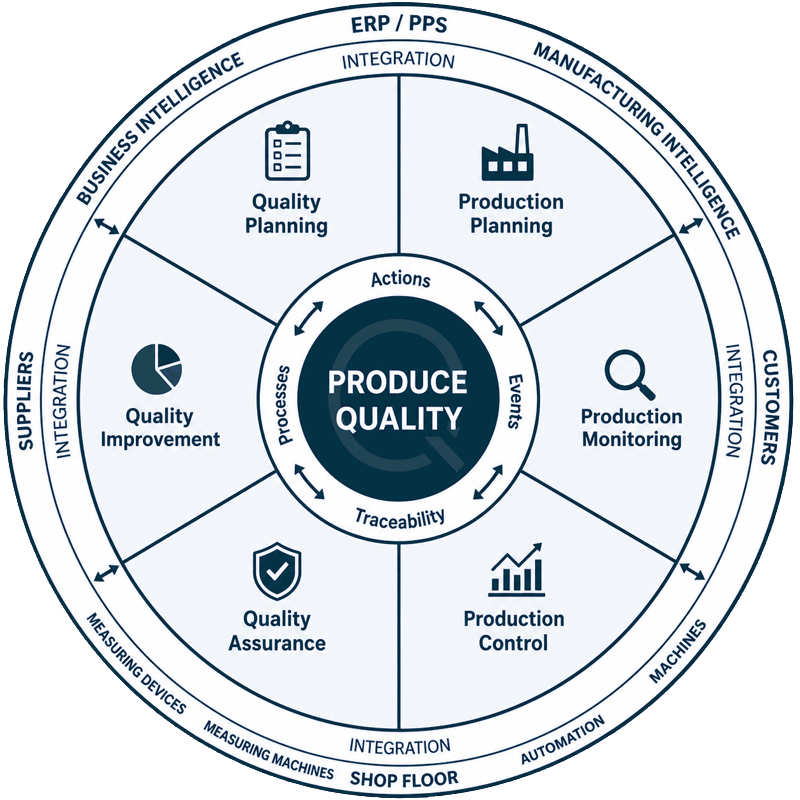
CAQ that produces quality
From inspection planning to operator guidance – modular, integrable, and SAP-compatible
- Significantly reduced inspection effort through CTQ and adaptive inspection strategies
- Zero-defect approach through inline inspection and machine integration
- End-to-end SAP integration and shopfloor connectivity
More than 45 years in manufacturing