Machine Capability Study
A machine capability study is a statistical method for evaluating the short-term performance of a single machine under defined, largely constant conditions. Its aim is to determine quantitatively whether a machine can meet specified tolerances reproducibly. In quality management, it is a key tool for safeguarding production start-up and series processes.
Machine Capability vs. Process Capability
A machine capability study needs to be distinguished from a process capability study:
- Machine capability: evaluation of a single machine under idealized conditions (without significant disturbances).
- Process capability: evaluation of the entire production process under real series conditions.
While machine capability analyzes the technical performance limit of the machine, process capability also takes into account additional influencing factors such as material variation, operator influence or environmental conditions.
Statistical Indices
The evaluation is usually based on capability indices, in particular:
- Cm: a measure of variation relative to the tolerance width
- Cmk: also takes into account the position of the mean within the tolerance
The calculation is based on samples taken under stable conditions. Sufficient data is a prerequisite for a reliable statistical conclusion.
The methodology is closely related to statistical process control, as both approaches are based on evaluating variance and on the assumption of a normal distribution.
Objectives and Applications
Typical applications are:
- initial sampling of new machines
- commissioning after modifications or repairs
- releasing equipment for series production
- providing evidence to customers or auditors
The study provides the basis for deciding whether the technical prerequisites for stable processes are in place.
The Role of the Machine Capability Study in the Quality Management System
Within quality assurance, the machine capability study helps to safeguard critical characteristics preventively. Under ISO 9001, organizations are required to ensure suitable processes for the provision of products and services. Evaluating machine capability is an operational means of meeting this requirement.
At the strategic level, it serves as a risk indicator; at the operational level, as a release criterion for production equipment.
Machine Capability Study vs. Measurement System Analysis
The machine capability study evaluates the performance of the machine. Measurement system analysis (MSA), on the other hand, examines the suitability of the measurement system used. The two analyses are independent of each other, but together they determine how meaningful statistical evaluations are.
FAQ – Frequently Asked Questions About the Machine Capability Study
What is a machine capability study?
A machine capability study is a statistical method for evaluating whether a single machine can reliably meet specified tolerances under stable conditions.
What do Cm and Cmk mean?
Cm describes the variation relative to the tolerance width. Cmk also takes into account the position of the mean within the tolerance limits.
How does it differ from process capability?
Machine capability looks at a single machine under ideal conditions, while process capability evaluates the entire production process under real series conditions.
Is a machine capability study required by standards?
It is not explicitly required by ISO 9001, but depending on the industry it is used as recognized evidence for production release.
Standards and Norms
The machine capability study is not a requirement of a standard in its own right, but in many industries, especially the automotive industry, it is required as established evidence for production release. It complements the normative requirements for process control and infrastructure within the quality management system.
Further Internal Content
AI-assisted · Editing and publication: Christian Sedlag · Last updated: 9 November 2026
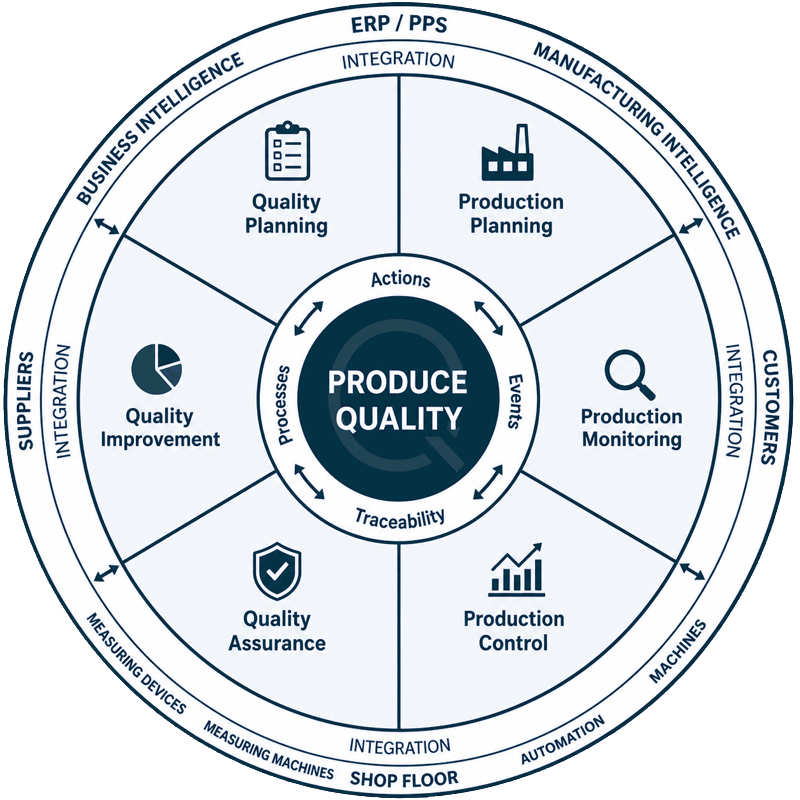
CAQ that produces quality
From inspection planning to operator guidance – modular, integrable, and SAP-compatible
- Significantly reduced inspection effort through CTQ and adaptive inspection strategies
- Zero-defect approach through inline inspection and machine integration
- End-to-end SAP integration and shopfloor connectivity
More than 45 years in manufacturing