PDCA Cycle: A Model for Systematically Improving Processes
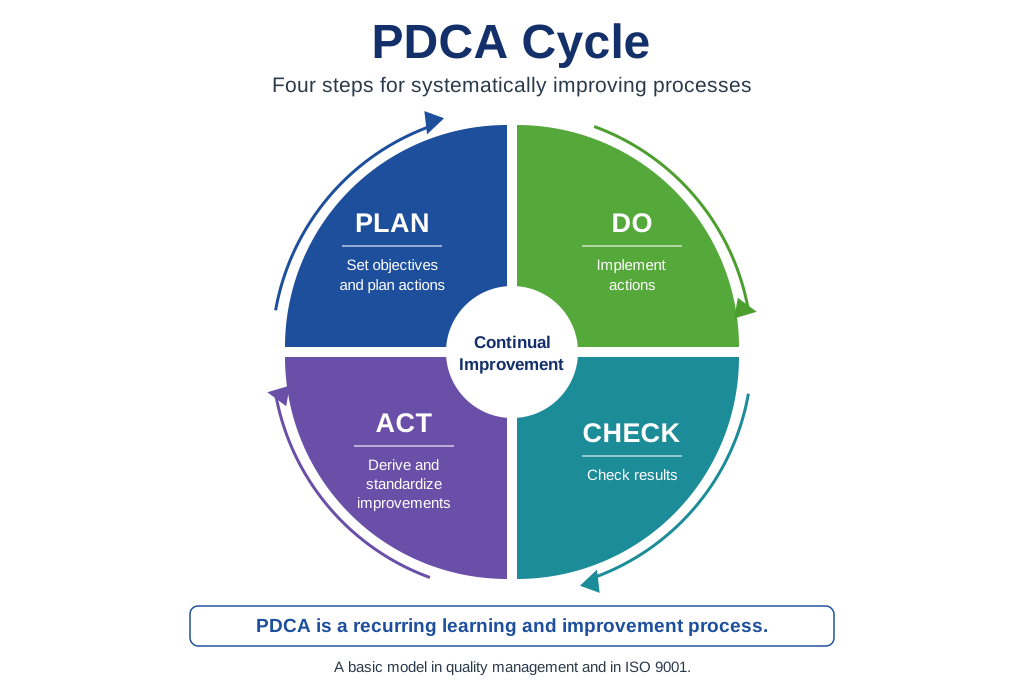
The PDCA cycle is a four-step, iterative model for systematically improving processes, products and services. It consists of the phases Plan, Do, Check and Act, which are repeated continuously. Each cycle builds on the findings of the previous one, so the PDCA cycle does not describe a one-time improvement step but a recurring learning process.
The PDCA Cycle in Quality Management
In quality management, the PDCA cycle is a fundamental control model for process-oriented improvement. It provides a methodological framework for quality assurance and can be combined with evaluations of statistical process control, for example when their results provide the data for the Check phase. In ISO 9001, the PDCA cycle is explicitly named as the model behind the process approach of the standard.
Origin and Development of the PDCA Cycle
The foundations of the PDCA cycle go back to the American physicist and statistician Walter A. Shewhart, who worked on statistical quality control at Western Electric in the 1920s and 1930s. His original model comprised three steps and was published in 1939. William Edwards Deming, who knew and built on Shewhart’s work, extended the model to the four-step form common today and promoted it in Japan from the 1950s onwards.
Deming himself consistently spoke of the Shewhart cycle, as he attributed the original idea to Shewhart. In the technical literature and in general usage, the term Deming cycle has also become established. In Japan, the PDCA cycle contributed significantly to the spread of Kaizen and thus had a lasting influence on the development of modern quality management methods.
The Four Phases of the PDCA Cycle
The PDCA cycle is divided into four consecutive phases:
- Plan: analyze the current situation, define objectives and plan the actions needed to achieve them
- Do: implement the planned actions, usually on a limited scale or under controlled conditions at first
- Check: compare the results with the objectives defined in the Plan phase, including evaluating whether the expected effect has been achieved
- Act: draw conclusions from the check – standardize successful actions, make adjustments if objectives are not met or start a new cycle
After the Act phase, the cycle begins again, if necessary with adjusted objectives or based on the findings gained in the meantime.
The PDCA Cycle and the Continuous Improvement Process (CIP)
The PDCA cycle needs to be distinguished from a continuous improvement process (CIP). CIP refers to the overarching organizational orientation of a company towards ongoing improvement as a principle. The PDCA cycle, by contrast, is a specific methodological tool with which this principle can be implemented in a structured way. A company can therefore pursue a CIP culture and use different methods in doing so, of which the PDCA cycle is one of the most widespread.
The PDCA Cycle in ISO 9001
ISO 9001 names the PDCA cycle as the model underlying the process approach required by the standard. The standard itself does not prescribe any particular procedure for implementing the PDCA cycle, but requires that processes are planned, implemented, monitored, and improved where necessary. How a company organizes the PDCA cycle in concrete terms, for example at the level of individual processes, entire process chains, or the entire quality management system, is at the discretion of the organization.
PDCA vs. Other Improvement Methods
The PDCA cycle is occasionally equated with the PDSA cycle (Plan-Do-Study-Act). In later years, Deming preferred the term “Study” instead of “Check” in order to emphasize that the third phase is not limited to a mere target/actual comparison, but includes an in-depth evaluation of the findings gained. In terms of content, both terms describe the same basic model.
The PDCA cycle differs from DMAIC, the process model used in Six Sigma projects (Define, Measure, Analyze, Improve, Control), in that it is less formalized. DMAIC is designed for clearly defined, mostly data-intensive improvement projects with a defined project completion, while the PDCA cycle, as a continuous, more broadly applicable basic model, is also suitable for smaller or more informal improvement steps.
Using the PDCA Cycle in Manufacturing
In manufacturing, the PDCA cycle is used in various contexts, for example when introducing new inspection procedures, handling complaints, or implementing actions from internal audits. The cycle provides the structural basis, but does not replace the content-related methodology of the respective task, such as a root cause analysis or a risk assessment. The effectiveness of an action implemented within the PDCA cycle must be demonstrated in the Check phase using suitable criteria; the PDCA cycle itself does not automatically provide this evidence.
FAQ – Frequently Asked Questions About the PDCA Cycle
What is the objective of the PDCA cycle?
The objective of the PDCA cycle is the systematic and recurring improvement of processes, products, or services through the structured completion of the phases Plan, Do, Check, and Act.
Where does the PDCA cycle come from?
The PDCA cycle goes back to a three-step model by Walter A. Shewhart from the 1930s, which William Edwards Deming extended to the four-step form common today and promoted in Japan from the 1950s onwards.
What is the difference between the PDCA cycle and the Deming cycle?
They are the same model under different names. Deming himself spoke of the Shewhart cycle, while the term Deming cycle has also become established in the technical literature.
Is the PDCA cycle part of ISO 9001?
ISO 9001 names the PDCA cycle as the model behind the process approach required by the standard, but does not prescribe any particular procedure for its implementation.
What is the difference between the PDCA cycle and DMAIC?
DMAIC is a more formal, mostly data-intensive process model for clearly defined Six Sigma projects with a defined project completion. The PDCA cycle, by contrast, is a continuous, more broadly applicable basic model with a lower degree of formalization.
Is the PDCA cycle a one-time procedure?
No. The PDCA cycle is designed as a recurring process: after the Act phase, the cycle begins again, if necessary with adjusted objectives.
What is the difference between PDCA and PDSA?
PDCA (Plan-Do-Check-Act) and PDSA (Plan-Do-Study-Act) refer to the same basic model. Deming preferred the term “Study” to emphasize the in-depth evaluation in the third phase as opposed to a mere target/actual comparison.
Standards and Norms
There is no separate standard for the PDCA cycle itself. Instead, it is included as a model in other standards: ISO 9001:2015 explicitly names the PDCA cycle in its introduction as the basis of the process approach required by the standard, without itself specifying a methodology for carrying it out. The full text of the standard is available for a fee via the official ISO catalog; the scope and abstract are freely accessible.
Further Internal Content
- Quality management as the overarching technical framework of the PDCA cycle
- Action management as the organizational framework for the Act phase
- Complaint management as a typical field of application of the PDCA cycle
AI-assisted · Editing and publication: Christian Sedlag · Last updated: 9 November 2026
CAQ that produces quality
From inspection planning to operator guidance – modular, integrable, and SAP-compatible
- Significantly reduced inspection effort through CTQ and adaptive inspection strategies
- Zero-defect approach through inline inspection and machine integration
- End-to-end SAP integration and shopfloor connectivity
More than 45 years in manufacturing