Six Sigma – Method for Systematic Process Improvement in Quality Management
Six Sigma is a data-driven, statistically grounded method for systematically reducing process variation and defect rates. Its goal is to design and control processes so that outcomes fall within a defined, narrow tolerance range and defect rates drop to a statistically negligible level. Six Sigma is an improvement methodology, not a quality management system in itself.
Systemic Position of Six Sigma Within Quality Management
Six Sigma is embedded within the framework of quality management as a structured improvement methodology and supports the continuous optimization of existing processes within quality assurance. It complements foundational statistical methods such as Statistical Process Control without replacing them, instead using them as an analytical tool within a broader improvement project.
Objectives and Core Logic of Six Sigma
The central objective of Six Sigma is to reduce the variation of process outcomes to the point where defects occur only at a statistically defined, very low frequency. The name derives from the statistical measure sigma (standard deviation), which describes the distance between the process mean and the tolerance limit.
The approach follows a defined sequence known as the DMAIC cycle:
- Define: Scoping the problem and project objectives
- Measure: Capturing and quantifying the current state
- Analyze: Identifying the causes of process variation
- Improve: Deriving and implementing improvement measures
- Control: Monitoring the sustainability of the achieved improvement
These five phases form a closed, iteratively applicable improvement cycle.
Role Structure Within Six Sigma
The methodology features a hierarchically structured role system, commonly referred to using belt colors (including Green Belt, Black Belt, and Master Black Belt). These roles differ in the scope of methodological responsibility and the complexity of the projects handled, but are not a normative part of the methodology itself, rather a widely adopted organizational convention in practice.
Distinction of Six Sigma from Other Quality Methods
A clear distinction from related concepts is necessary:
- Six Sigma is neither a standard nor a management system, but a project-based improvement method.
- It differs from the PDCA cycle through a more statistically formalized, data-intensive process with defined analytical tools.
- Combined with Lean principles, it forms Lean Six Sigma, which addresses process efficiency and defect reduction together, without the original methodology losing its distinct structure.
Relationship Between Six Sigma, Process Capability, and Statistical Process Monitoring
Six Sigma projects use process capability metrics to quantitatively assess the current state and improvement progress. Data collected through Statistical Process Control frequently forms the data basis for the Measure and Analyze phases of a Six Sigma project.
Role of Six Sigma in Industrial Manufacturing
In manufacturing, Six Sigma is used primarily to reduce scrap, rework, and process variation in existing series production processes. Its effect can be observed across several levels:
- Organization: Structured, project-based improvement work
- Leadership: Data-based decision foundations instead of subjective assessment
- Processes: Traceable reduction of variation and root causes
- Culture: Establishing measurable, fact-based improvement thinking
Normative Classification of Six Sigma
Six Sigma is not a standard but a recognized improvement method used across numerous industries. It does not conflict normatively with ISO 9001 or IATF 16949, but can be applied as a methodological tool within a standard-compliant quality management system without itself being normatively mandated.
FAQ – Frequently Asked Questions About Six Sigma
What is the goal of Six Sigma?
The goal of Six Sigma is the systematic reduction of process variation and defect rates through a structured, data-driven improvement cycle.
What does DMAIC mean?
DMAIC refers to the five phases of a Six Sigma project: Define, Measure, Analyze, Improve, and Control.
Is Six Sigma a quality management system?
No. Six Sigma is a project-based improvement method, not a standalone management system.
What distinguishes Six Sigma from the PDCA cycle?
Six Sigma uses a more statistically formalized process with defined analytical tools, while the PDCA cycle describes a more general, iterative improvement principle.
What is Lean Six Sigma?
Lean Six Sigma combines the defect-reduction focus of Six Sigma with the efficiency principles of Lean management.
Is Six Sigma dependent on software?
The method itself is independent of software; IT systems merely support data collection, evaluation, and documentation of the project phases.
Standards and Norms
Six Sigma is not codified in a dedicated ISO standard but is methodologically described in the international standard ISO 13053. No direct normative link to ISO 9001 or IATF 16949 exists; however, Six Sigma can be applied as a complementary approach within a quality management system built on these standards.
Further Related Content
Last updated: 28.07.2026.
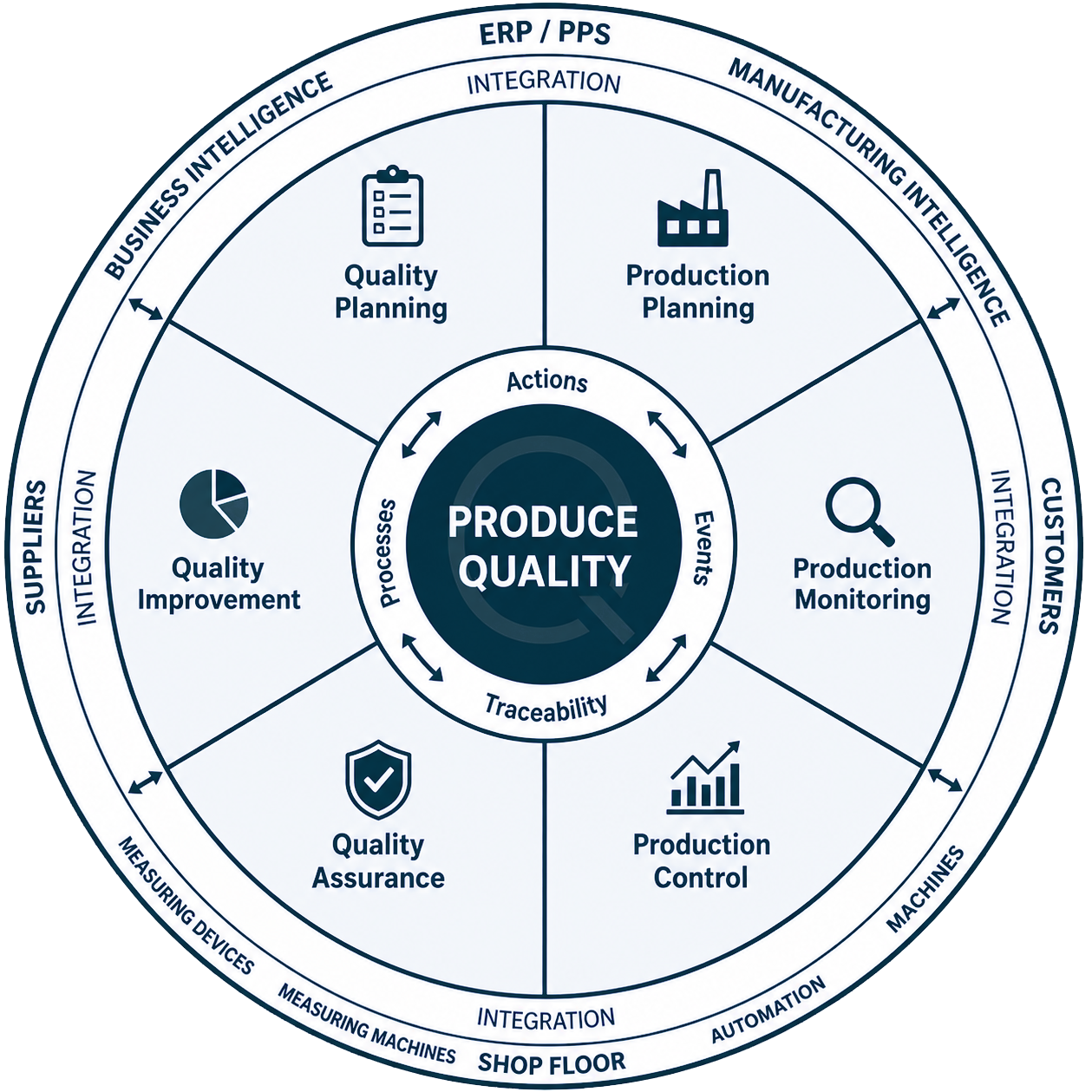
CAQ that produces quality
From inspection planning to operator guidance – modular, integrable, and SAP-compatible
- Significantly reduced inspection effort through CTQ and adaptive inspection strategies
- Zero-defect approach through inline inspection and machine integration
- End-to-end SAP integration and shopfloor connectivity
More than 45 years in manufacturing