Total Quality Management (TQM)
Total quality management (TQM) refers to a holistic management approach that anchors quality as a strategic leadership principle throughout the entire organization. Its objective is the continuous improvement of all processes, products, and services with the involvement of all employees and organizational levels.
TQM goes beyond operational quality assurance and understands quality as an integral part of corporate strategy. It represents a cultural and structural extension of classic quality management.
Definition and Basic Understanding
The term “total” refers to the comprehensive involvement of all functions, processes, and hierarchical levels. “Quality” is not understood exclusively as product quality, but as the fulfillment of defined requirements of all relevant stakeholders. “Management” emphasizes leadership responsibility for quality as a strategic task.
TQM is based on the assumption that sustainable competitiveness can only be achieved through systematic process control, continuous improvement, and a pronounced quality culture.
Systemic Role in the Quality Management System
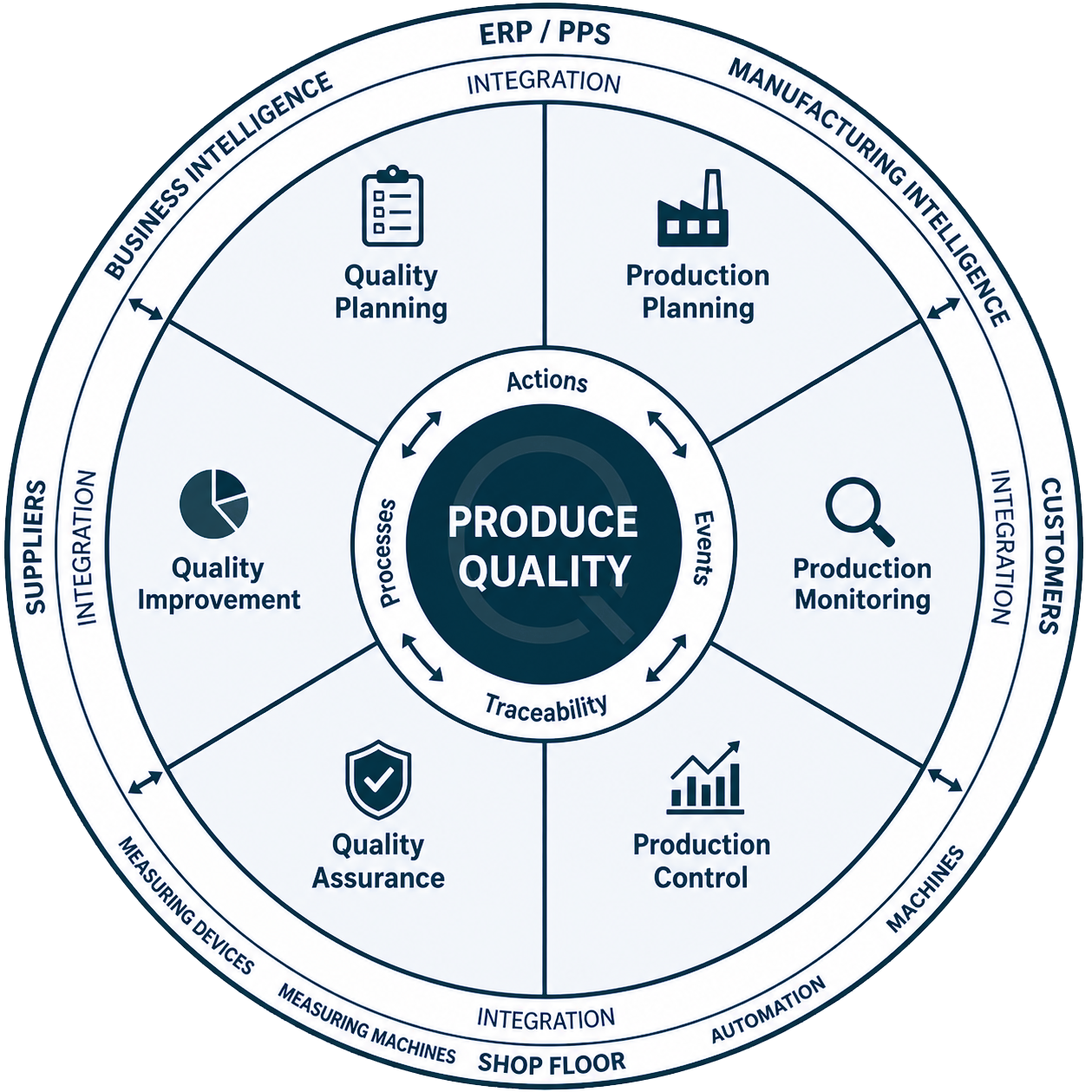
Total quality management is a master term within the quality context. Its effect unfolds at several levels:
Organization
Structural anchoring of quality objectives, clearly defined responsibilities, and transparent process landscapes.
Management
Quality as part of corporate strategy and leadership principles. Management responsibility includes the active control and evaluation of quality performance.
Processes
Consistent process orientation, measurability of performance indicators, and the systematic use of improvement methods such as the A3 method or FMEA.
Culture
Promotion of a culture of learning from errors and of improvement, in which employees actively contribute to the development of quality.
Strategic, Tactical, and Operational Classification
Strategic Level
Definition of long-term quality objectives and their integration into the corporate mission statement and policy. There is a close connection with the quality policy here.
Tactical Level
Definition of indicator systems, target agreements, and improvement programs for the systematic control of quality performance.
Operational Level
Implementation of specific measures for process optimization, defect prevention, and stabilization, for example using methods of statistical process control.
Basic Principles of TQM
- customer orientation as the highest quality criterion
- process-oriented thinking
- leadership and the role-model function of management
- employee involvement and qualification
- continuous improvement (Kaizen)
- fact-based decision making
These principles are closely related to the PDCA cycle (Plan-Do-Check-Act) and form the conceptual basis of modern quality management systems.
Normative Classification
ISO 9001 provides a normative framework for quality management systems. TQM is not a standard, but an overarching management approach whose principles are reflected in many requirements of ISO 9001, in particular in the process approach and in risk-based thinking.
In industry-specific standards such as IATF 16949, TQM principles are specified in more detail through additional requirements for defect prevention, process capability, and continual improvement.
Distinction: TQM and Quality Management System
A quality management system describes the structured implementation of normative requirements. Total quality management, on the other hand, is a comprehensive management philosophy that includes organizational culture, leadership attitude, and strategic orientation.
While a QM system can be formally certified, TQM as a management approach cannot be certified against a standard, but is an expression of a company-wide understanding of quality.
Maturity and Organizational Development
The implementation of TQM can show different levels of maturity:
- formal introduction of a QM system without cultural anchoring
- integration of quality indicators into management decisions
- a consistent quality culture with continuous improvement at all levels
Maturity is evident in particular in the consistency between strategic objectives and operational implementation.
FAQ – Frequently Asked Questions About Total Quality Management
What is meant by total quality management?
Total quality management is a holistic management approach that anchors quality as a strategic leadership principle throughout the entire organization.
Is TQM a standard like ISO 9001?
No. TQM is a management philosophy. ISO 9001 is a certifiable standard for quality management systems.
What role does management play in TQM?
Management bears strategic responsibility for quality, defines objectives, provides resources, and promotes a quality culture.
How does TQM differ from quality assurance?
Quality assurance focuses on operational measures for preventing and detecting defects. TQM additionally covers strategic, cultural, and organizational aspects.
Standards and Norms
- ISO 9001 – quality management systems
- IATF 16949 – quality management in the automotive industry
- Total quality management (Wikipedia)
Further Internal Content
AI-assisted · Editing and publication: Christian Sedlag · Last updated: 28 October 2026
CAQ that produces quality
From inspection planning to operator guidance – modular, integrable, and SAP-compatible
- Significantly reduced inspection effort through CTQ and adaptive inspection strategies
- Zero-defect approach through inline inspection and machine integration
- End-to-end SAP integration and shopfloor connectivity
More than 45 years in manufacturing