What Are Quality Costs and Cost of Poor Quality (COPQ)?
Quality costs are the costs of preventing, detecting and correcting quality deviations. The classic prevention-appraisal-failure model (PAF model) divides them into prevention costs, appraisal costs, and internal and external failure costs. The umbrella term is cost of quality (COQ).
In the failure-related definition used here, cost of poor quality (COPQ) is the sum of internal and external failure costs. COPQ therefore reflects the economic consequences of poor quality. It is not the same as total quality costs. The literature also contains broader COPQ models, so a COPQ figure is only unambiguous when its cost definition is stated.
Which Cost Categories Make Up Quality Costs?
| Cost category | Classification | Examples from manufacturing |
|---|---|---|
| Prevention costs | Effort to prevent quality deviations | Quality planning, quality-related training, preventive process analyses |
| Appraisal costs | Effort to verify conformity with requirements | Incoming inspection, in-process measurements, final inspection |
| Internal failure costs | Failure-related effort before delivery to the customer | Scrap, rework, failure-related sorting and re-inspection |
| External failure costs | Failure-related effort after delivery to the customer | Complaint handling, return shipping, replacement delivery, warranty and recall |
Costs are assigned according to the reason for an activity. A regular final inspection is an appraisal cost. An additional inspection after rework caused by a defect, however, is a failure cost. Organizational responsibility is not decisive: failure costs can arise in production, logistics, service or administration.
How Are Quality Costs and COPQ Calculated?
Within this model, the following relationships apply:
Quality costs = prevention costs + appraisal costs + internal failure costs + external failure costs
COPQ = internal failure costs + external failure costs
A revenue-based failure cost ratio relates the COPQ recorded in a period to the revenue of the same period:
COPQ ratio = COPQ / revenue × 100%
Other reference values, such as manufacturing costs or units produced, result in different key figures. Their name and interpretation depend on the denominator. A failure cost ratio of 2% of revenue is not directly comparable with a failure cost ratio of 2% of manufacturing costs.
Calculation Example from Manufacturing
The following simplified example uses fictitious monthly figures. The cost items do not overlap.
| Cost item | Amount |
|---|---|
| Prevention costs | €8,000 |
| Regular appraisal costs | €12,000 |
| Internal failure costs | €18,000 |
| External failure costs | €7,000 |
| Total quality costs | €45,000 |
| COPQ | €25,000 |
With monthly revenue of €1,000,000, the revenue-based COPQ ratio is 2.5%. Total quality costs, by contrast, amount to 4.5% of revenue. The two figures describe different things.
How Do Failure Costs Arise in the Production Process?
A quality deviation can arise as early as material provision or machining but only be detected in a later inspection or by the customer. Further machining, assembly and transport steps can take place between the occurrence and the detection of a defect. The economic loss therefore also depends on the value already added and on the number of parts affected.
For example, a dimensional deviation on a turned part can mean lost material and machining time. If the part has already been installed in an assembly, disassembly, replacement and a repeat functional test may be added. The type of defect stays the same, while the economic consequences differ.
However, a process value outside its usual range is not yet a monetary loss. A reliable cost evaluation is only possible when the process state, a verified quality deviation and the effort it caused are linked. A statistical correlation between process and quality data does not in itself prove a cause.
Which Failure Costs Often Remain Hidden?
How meaningful a COPQ evaluation is depends on which costs are recorded. In addition to directly booked costs, failure-related coordination, additional planning, special shipments or tied-up capacity can be relevant.
Opportunity costs, such as lost contribution margin because a bottleneck machine is occupied, need to be distinguished from costs actually incurred. They only arise economically under corresponding capacity utilization and sales conditions. In addition, reputational damage and possible future revenue losses can often only be assessed as uncertain estimates.
A cost total remains traceable if booked amounts, imputed valuations and estimated consequential effects are reported separately. Double counting occurs, for example, if the full manufacturing cost of a scrapped part is added on top of the material and machining costs it already contains.
How Meaningful Are Quality Cost KPIs?
COPQ adds an economic perspective to technical KPIs. A scrap rate describes a share of quantity; a failure cost ratio describes a valued loss. A few defective, complex components can cause higher costs than many simple parts.
Time series are influenced by product mix, volumes, cost rates and the scope of recording, among other factors. An increase in recorded COPQ can be due to more defects, but also to more complete cost recording. External failure costs can also occur months after production. A period-based view and an assignment to the original production lot therefore answer different questions.
Falling appraisal costs alone do not prove that quality has improved. They can be related to more stable production, but also to reduced inspection depth. The economic evaluation therefore results from the relationship between prevention, appraisal, failure consequences and remaining risk. COPQ describes consequences that have already been valued; the figure does not replace an assessment of safety-critical risks.
What Role Do CAQ, MES and ERP Play?
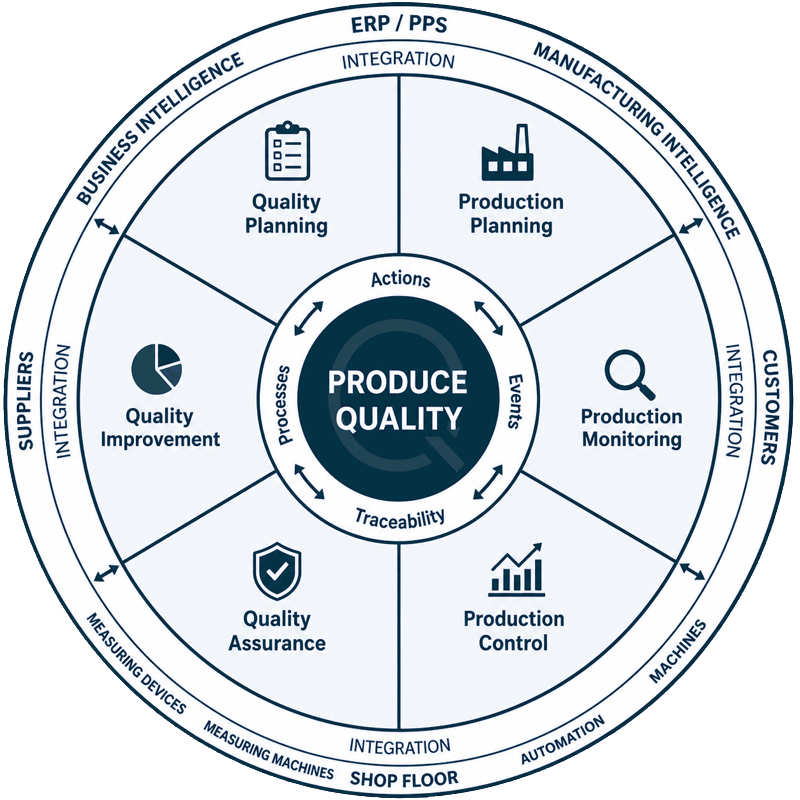
Quality cost accounting links technical events with their monetary valuation. A CAQ system can, for example, document deviations, inspection results, complaints and actions. Depending on its configuration, an MES provides production quantities, processing times and process context. The ERP system often holds material values, order costs and financial postings.
This information is linked via common references such as item, order, operation, batch or serial number. The occurrence of a defect, its detection and the cost posting are separate events. How they are assigned determines whether an evaluation describes the affected production unit or merely the time of posting.
Software supports data capture and evaluation. However, it does not automatically determine which costs count as COPQ. This definition is part of the company’s cost model and remains necessary even with integrated systems.
What Does a Quality Cost Report Typically Contain?
A quality cost report presents the quality-related costs for a defined period and scope. Typical contents are:
- Reporting scope: period, plants, products or processes covered, as well as data sources and valuation basis.
- Cost overview: prevention costs, appraisal costs, and internal and external failure costs; COPQ as a separate total of failure costs.
- Cost drivers: breakdowns by defect type, product, process or complaint case, where the data allow a reliable assignment.
- KPIs and trends: absolute amounts, clearly labeled cost ratios, and comparisons with previous periods or internally defined targets.
- Context: explanations of significant changes, of the status of related actions and of verifiable economic effects.
- Limitations: unrecorded costs, estimates, changed cost rates and possible time lags between the occurrence of a defect and the cost posting.
A pure COPQ evaluation contains only failure costs and therefore covers only part of total quality costs. For comparisons, it is essential that cost scope, reference values and valuation rules match, or that differences are disclosed.
FAQ – Frequently Asked Questions About Quality Costs and COPQ
What is the difference between quality costs and COPQ?
In the PAF model, quality costs include prevention costs, appraisal costs, and internal and external failure costs. In the failure-related definition, COPQ covers only internal and external failure costs.
Are regular appraisal costs part of COPQ?
In the model used here, regular appraisal costs are not part of COPQ. Additional inspections required because of a defect or rework, however, count as failure costs.
Is COPQ the same as scrap costs?
No. Scrap costs are one component of internal failure costs. COPQ also includes other internal and external failure costs, such as rework and failure-related complaint handling.
What is the difference between internal and external failure costs?
Internal failure costs relate to defects detected before delivery to the customer. External failure costs relate to defects detected after delivery to the customer.
Can a higher COPQ figure be the result of better data recording?
Yes. If previously unrecorded failure-related costs are included for the first time, the figure can rise even though the actual defect frequency has not changed.
What does a quality cost report typically contain?
A quality cost report typically contains the reporting period and scope, a breakdown by cost category, the COPQ total, significant cost drivers, KPIs and comparisons over time. It also explains changes and related actions, as well as data sources, valuation rules and the limits of what was recorded.
Standards and Norms
ISO 9001 provides the overarching framework for quality management systems. Quality cost KPIs add an economic perspective to the evaluation of processes. The PAF model is a cost classification model; it is neither a management system standard in its own right nor a software function. The classification described here does not imply a general normative requirement for a specific COPQ formula or a uniform target value.
The topic relates to quality management, quality assurance and statistical process control. The normative framework is described under ISO 9001.
Further Internal Content
- Complaint management: classifying and handling complaint cases
- Action management: how deviations relate to actions
- Statistical process control: monitoring process behavior
AI-assisted · Editing and publication: Christian Sedlag · Last updated: 9 November 2026
CAQ that produces quality
From inspection planning to operator guidance – modular, integrable, and SAP-compatible
- Significantly reduced inspection effort through CTQ and adaptive inspection strategies
- Zero-defect approach through inline inspection and machine integration
- End-to-end SAP integration and shopfloor connectivity
More than 45 years in manufacturing