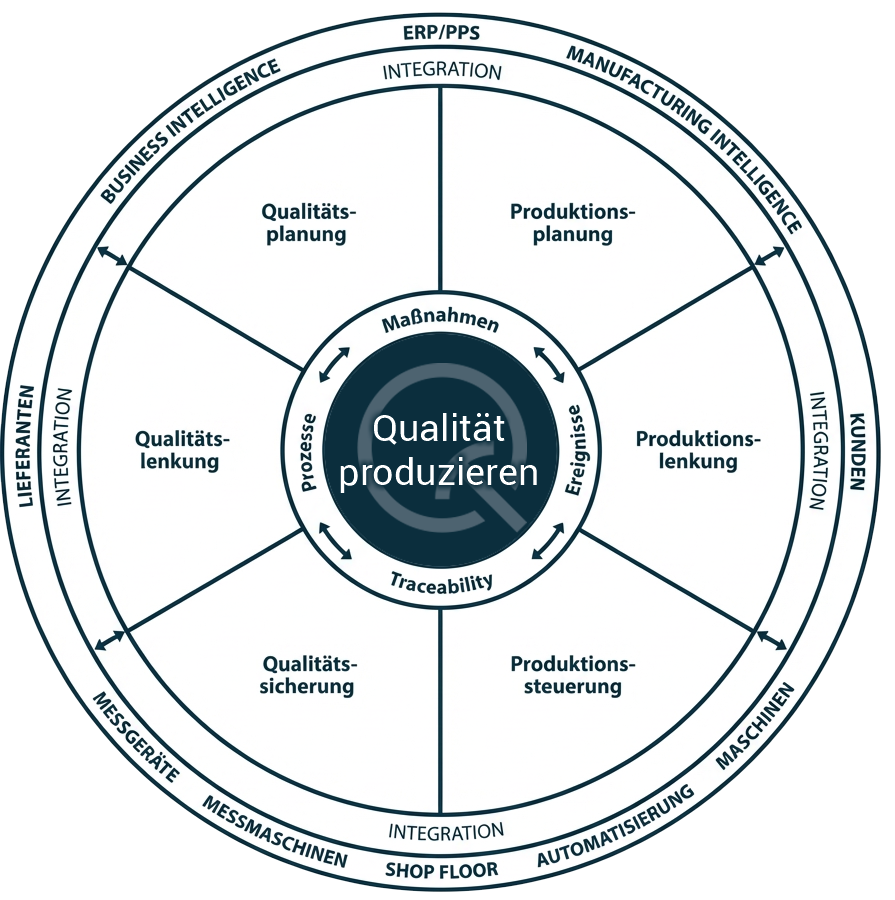
What Is Integrated Process Control (IPC)?
Integrated Process Control (IPC) is an integrated approach to monitoring and controlling production processes. Different methods and mechanisms of process control are not considered in isolation, but are combined in such a way that process changes can be detected, evaluated and influenced through appropriate actions.
The underlying concept originates from process and production engineering. In the technical literature, Integrated Process Control is described, among other things, as a combination of approaches such as Statistical Process Control (SPC), Total Productive Maintenance (TPM) and Automated Process Control (APC). These approaches share the objective of controlling process variation and thereby improving product quality, equipment availability and economic efficiency.
IPC is neither a specific software solution nor a prescribed method. Which control mechanisms are appropriate depends on the individual production process.
Distinction: Other Meanings of the Abbreviation IPC
The abbreviation IPC has several meanings and is used in very different contexts by quality and production professionals. This article deals exclusively with Integrated Process Control.
| Abbreviation | Meaning | Context |
|---|---|---|
| IPC | Integrated Process Control | Integrated control of production processes – the subject of this article |
| IPC | In-Process Control | In-process inspections in pharmaceutical manufacturing and GMP environments |
| IPC | IPC Standards for Electronics Manufacturing | Standards such as IPC-A-610 or IPC-A-600; the issuing association has operated as the Global Electronics Association since 2025 |
| IPC | Inter-Process Communication | Communication between processes in information technology |
In terms of content, pharmaceutical In-Process Control is the closest concept because it also involves inspections during production. However, it describes a regulatory-driven inspection activity performed during manufacturing, whereas Integrated Process Control refers to the interaction of multiple control and response mechanisms.
What Does Integrated Process Control Mean in Production?
Production processes are subject to various influences and fluctuations. Material, machines, tools, environmental conditions, process parameters and operators can all affect the result.
Process control therefore begins with detecting relevant changes and being able to respond to them appropriately.
Capture → Evaluate → Respond → Verify Effectiveness
The process state is captured. The available information is evaluated using appropriate criteria. If action is required, a predefined response is triggered. It must then be possible to determine whether the action has restored the desired process state.
How these steps are implemented depends on the process. A response may, for example:
- notify an operator,
- trigger an additional inspection,
- adjust the inspection frequency,
- block or reject a product,
- request a tool change,
- interrupt a process,
- or automatically adjust a process parameter.
Not every one of these cases constitutes a closed-loop technical control system. Such a closed loop can be created when process information is automatically fed back to a manipulated variable. In other processes, the response is deliberately carried out by an operator or a higher-level system.
Integrated Process Control therefore encompasses more than automated process control.
How Does IPC Differ from SPC?
Statistical Process Control (SPC) is an established method for statistically monitoring process variation.
Control charts can indicate whether a process is statistically stable or whether special causes are affecting it. Process capability indices such as Cp or Cpk, on the other hand, answer a different question: how the process distribution relates to specified specification limits.
Integrated Process Control has a broader scope.
SPC can be one component of an IPC concept. In addition, machine states, process parameters, maintenance information, inspections, Poka Yoke or automated control mechanisms can contribute to process control.
SPC is a tool for process monitoring. IPC considers how appropriate tools work together to achieve process control.
Which of these tools are required depends on the process.
How Does Quality Miners Apply the IPC Concept to Quality Management?
Quality Miners does not consider Integrated Process Control to be a separate standard.
We apply the general concept of integrated process control to the connection between quality requirements and the production process.
The central question is:
How should quality requirements be integrated into a production process so that they become effective during production?
From a quality perspective, this results in a relationship such as:
Quality Requirement → Process → Measurement → Evaluation → Response → Verification
Quality is therefore not merely documented after a process step has been completed. Quality information is used to monitor the production process and to intervene where this is appropriate from a quality perspective and technically feasible.
This is what we mean by Producing Quality.
What Role Do FMEA, Control Plan, MSA and SPC Play in IPC?
Integrated Process Control does not replace established quality methods.
Methods from quality planning and quality assurance can instead provide the relevant information used to monitor and control a process.
| Method | Contribution to Process Control |
|---|---|
| FMEA | Analyzes potential failures, effects, causes and risks associated with a product or process. |
| Control Plan | Defines the control methods, characteristics and responses planned for production. |
| MSA / VDA Volume 5 | Evaluates whether measurement and inspection processes are suitable for the respective measurement task. |
| SPC | Monitors process variation using statistical methods and can make changes in process behavior visible. |
| Poka Yoke | Prevents or detects specific errors directly within the process. |
| TPM | Addresses, among other things, the technical condition and availability of production equipment. |
| APC | Influences process variables through automated process control. |
These methods do not constitute a prescribed “IPC methodology chain.” Depending on the production process, individual, multiple or additional control mechanisms may be required.
The essential idea behind IPC is not to consider them in isolation.
Why Is Production Data Alone Not Enough?
Modern production environments generate large volumes of data. Machines provide process parameters. Measurement systems capture quality characteristics. ERP systems provide material and production order information. MES systems map production workflows. CAQ systems manage inspection requirements and quality results.
However, the mere availability of this data does not mean that a process is under control.
A temperature value, torque value or measured diameter has only limited significance on its own.
For a meaningful technical evaluation, it must be known, for example:
- Which process does the value relate to?
- Which product is being manufactured?
- Which requirement applies?
- Which machine and tool were involved?
- What was the process state?
- Is the detected change relevant?
- Which response is defined?
Data integration is therefore a prerequisite for many IPC applications, but it does not constitute process control on its own.
What matters is placing the right data into the appropriate process control context.
What Role Does the Production Context Play?
Process and quality information require an appropriate reference in order to be related to one another.
Depending on the production environment, this production context may be:
- an individual component,
- a serial number,
- a batch,
- a lot,
- a production order,
- a process step,
- a machine,
- a tool,
- or a specific production period.
A serial number is therefore not always required.
In discrete manufacturing, it may provide the decisive reference. In a continuous process, however, a combination of material batch, equipment and time window may provide the necessary context.
What should the information be linked to so that the process state, quality requirement and response can be clearly associated with one another?
What Role Does Traceability Play in Integrated Process Control?
Traceability and Integrated Process Control are not the same thing.
Track & Trace, or traceability, generally describes the ability to trace the origin, processing, history or location of products, materials or other units. The specific requirements vary depending on the industry, product and regulatory environment.
For IPC, traceability can perform an important function because it establishes the necessary production context.
This makes it possible, for example, to determine:
- which material was used,
- which machine was used for production,
- which tool was used,
- which process conditions were present,
- which inspections were performed,
- and which other products were manufactured under comparable conditions.
Two questions are particularly relevant:
Understand the origin: Under which conditions was this product manufactured?
Determine the impact: Which other components, batches or production orders could be affected by the same conditions?
Traceability can therefore be an important building block in an IPC implementation. However, it is neither a prerequisite for every form of IPC nor part of its definition.
Does Traceability Automatically Create a Digital Twin?
No.
Linking product, process and quality information initially creates a structured digital production and traceability context.
Whether this constitutes a digital twin in the technical sense depends on additional requirements relating to the model, state, data integration and, where applicable, the dynamic representation of the real-world object or process.
A complete digital component history should therefore not automatically be referred to as a digital twin.
Nor is this term necessary for process control.
Does Integrated Process Control Require an MES or CAQ System?
No.
IPC primarily describes an approach to process control, not a prescribed IT architecture.
In a digitalized production environment, relevant information can come from sources such as:
| System / Level | Typical Information |
|---|---|
| ERP / SAP | Material, production order, batch, master data |
| MES | Production workflow, production order, process progress |
| CAQ | Inspection planning, quality requirements, measurement values, quality decisions |
| Machine / PLC | Process parameters, states, events |
| Measurement System | Measurement and inspection results |
| Maintenance | Machine condition, maintenance information |
Industrial interfaces and standards such as OPC UA or MQTT can be used to technically connect these levels.
The objective is not to connect as many systems as possible. What matters is making exactly the information available that is required to control the respective process.
What Role Do Standards Play in Integrated Process Control?
Integrated Process Control is not a software solution or quality method prescribed by IATF 16949 or ISO 9001.
However, standards and industry-specific requirements define requirements for the control of production processes.
In the automotive sector, IATF 16949, for example, addresses Control Plans, production process monitoring, Total Productive Maintenance, reaction plans, as well as identification and traceability. However, it does not prescribe a specific technical IPC concept as a tool.
An IPC approach can instead help to technically connect such requirements in a digitalized production environment so that they work together effectively.
There is also no single general standard for traceability and Track & Trace that applies to all manufacturing companies. Different standards and regulatory requirements apply depending on the field of application.
Examples include:
- IATF 16949 for identification and traceability in automotive quality management,
- ISO 21849 for product identification and traceability in aerospace,
- ISO 22005 for traceability in the feed and food chain,
- ISO 22095 as a general framework for chain-of-custody models.
The requirements that are actually relevant must therefore always be derived from the industry, product, customer requirements and regulatory context.
What Does Integrated Process Control Look Like in a Specific Process?
A simple example is the machining of a quality-critical dimension.
An inspection strategy is defined for the characteristic. Measurement values are captured during production. SPC or other monitoring methods can make changes in process behavior visible.
A relevant change can then be evaluated together with additional information, such as:
- tool condition,
- machine,
- material batch,
- process parameters,
- time,
- components already produced.
Depending on the defined quality and process strategy, this may trigger an additional inspection, tool change, blocking action or process interruption.
If automated control is appropriate from a process perspective and technically permissible, a manipulated process variable can also be adjusted.
The core idea of IPC is that measurement, evaluation and response do not take place independently of one another.
Practical Example: Traceability at Breyden (iDisc®)
A practical example of a particularly comprehensive production context is brake disc manufacturing at Breyden, formerly Buderus Guss.
For the iDisc®, components are uniquely identified using a DataMatrix code. This allows information from different production and inspection steps to be assigned to the respective product.
Machining centers are connected via OPC UA. Measurement and process information is captured digitally and linked to the product context.
In the event of a deviation, this makes it possible to determine:
- the conditions under which a component was manufactured,
- which quality information is available,
- and which additional production scope may potentially be affected.
Traceability itself is not Integrated Process Control. It establishes the context on the basis of which quality and process information can be evaluated and targeted responses can be enabled.
Learn more about the Breyden practical example
What Benefits Can Integrated Process Control Provide?
The specific benefits depend on the respective production process and the chosen implementation.
Quality Management
Quality and process information can be analyzed in context. Deviations do not have to be reconstructed retrospectively using separate data sources alone.
Production
Relevant quality information can be made available during production, allowing predefined responses to be triggered earlier.
IT and Digitalization
Existing systems can be connected in a targeted way. The process itself determines which integrations are actually required.
Management
Quality risks and the impact of deviations can become more transparent. At the same time, digital records of the production process can be created.
However, IPC does not automatically guarantee these outcomes. It requires a well-understood process, appropriate data, and defined control and response mechanisms.
In Which Production Areas Is IPC Useful?
Integrated Process Control is not limited to a specific industry.
The approach can be particularly relevant where:
- product quality is strongly dependent on the process state,
- critical characteristics are monitored,
- multiple data sources need to be combined,
- scrap or rework costs are high,
- process deviations need to be detected as early as possible,
- a high degree of traceability is required,
- or automated and manual process responses work together.
The specific implementation varies accordingly.
In machining, tool condition, machine data and dimensional trends may be decisive.
In assembly, component identification, torque, completeness and process approvals may be the main focus.
In battery production, the relevant data context may change along the value chain from material batches to cells and ultimately to modules.
The underlying principle remains the same. The specific approach to process control follows the requirements of the respective application.
How Does Quality Miners Approach an IPC Project?
We do not begin by asking which software function should be used.
We begin with the process:
- What needs to be controlled?
- Which quality requirements apply?
- Which information is required for evaluation?
- Which response is defined in the event of a deviation?
- Which systems and integrations are actually required?
Only then can we determine which combination of inspection requirements, measurement values, process parameters, machine information, material and production order data, traceability and predefined responses is required for the specific application.
This is the connection between Integrated Process Control and our understanding of Quality Mining:
Producing quality. Not just documenting it.
FAQ – Frequently Asked Questions About Integrated Process Control
What Does Integrated Process Control Mean?
Integrated Process Control is an integrated approach to controlling production processes. Different control mechanisms are considered together and applied in such a way that process states can be captured, evaluated and influenced when necessary.
What Else Does the Abbreviation IPC Stand For?
IPC has several meanings. In pharmaceutical manufacturing, IPC stands for In-Process Control; in electronics manufacturing, it refers to IPC standards such as IPC-A-610; and in information technology, it stands for Inter-Process Communication. This article discusses Integrated Process Control in the context of production process control.
Is IPC a Standalone IT System?
No. Integrated Process Control is primarily an approach to process control. Software can provide the technical implementation, but software itself does not define IPC.
Is IPC the Same as SPC?
No. SPC is a statistical method for monitoring process variation and can be part of an IPC concept. IPC also considers additional mechanisms for process monitoring and process control.
Are FMEA and Control Plan Part of IPC?
Not by definition. They are established quality methods. In a quality-driven IPC approach, they can provide important information about risks, characteristics, inspection strategies and predefined responses.
Is Traceability a Mandatory Part of IPC?
No. Traceability is a separate concept. However, it can be highly important for IPC because it assigns product, process and quality information to a clearly defined production context.
Is Every IPC Application a Closed-Loop Control System?
No. Responses can be manual, partially automated or fully automated. A closed-loop technical control system is created only when a measured process state is automatically fed back to a manipulated variable.
Does IPC Require an MES?
No. The required system architecture depends on the specific process. Information can come from ERP, CAQ, MES, machines, controllers and measurement systems, for example.
Is IPC Required by IATF 16949?
No. IATF 16949 does not prescribe a specific Integrated Process Control system. However, it contains requirements relating to the control and monitoring of production processes, including Control Plans, responses and traceability.
Is There a Dedicated IPC Standard?
Integrated Process Control is not standardized as a uniform method by ISO or IATF. However, numerous standards, industry rules and sector-specific requirements exist for individual aspects of process control and traceability.
Does Integrated Process Control Require Artificial Intelligence?
No. IPC can be implemented using established quality methods, statistical methods, deterministic rules and conventional process control. AI can complement these approaches for advanced analysis, but it is not a prerequisite.
Technical Sources and Standards
- W. A. J. Schippers: An integrated approach to process control, International Journal of Production Economics, Vol. 69, Issue 1, 2001, pp. 93–105.
- IATF 16949:2016 including published Sanctioned Interpretations.
- ISO 21849:2022: Aircraft and space — Industrial data — Product identification and traceability.
- ISO 22005:2007: Traceability in the feed and food chain — General principles and basic requirements for system design and implementation.
- ISO 22095:2020: Chain of custody — General terminology and models.
- AIAG/VDA FMEA Handbook.
- AIAG Control Plan.
- AIAG Measurement Systems Analysis and VDA Volume 5.
Related Content
Process Control Methods
- What Is Statistical Process Control (SPC)?
- What Is Process Capability?
- What Is a Machine Capability Study?
Quality Planning and Quality Assurance
Systems, Data and Interfaces
Standards and Practice
Editorial content: Quality Miners GmbH.
Last updated: September 16, 2026.
CAQ That Produces Quality
From Inspection Planning to Operator Guidance – Modular, Integrable and SAP-Ready
- Significantly reduced inspection effort through CTQ and adaptive inspection strategies
- Zero-defect route: inline inspection with machine connectivity
- End-to-end SAP integration and shop floor connectivity
- 45+ years of experience in manufacturing