Maintenance
Maintenance refers to all technical and organizational measures for preserving and restoring the specified condition of plant, machines and equipment. Its aim is to ensure functionality, availability and process stability in an industrial environment. In quality management, maintenance has a direct effect on product quality, process capability and delivery capability.
Maintenance Terminology According to DIN 31051
According to DIN 31051, maintenance is divided into four basic activities:
- Servicing: measures to slow down the depletion of the existing wear reserve
- Inspection: determining and assessing the actual condition
- Repair: restoring the functional condition
- Improvement: technical measures to increase reliability
This structure shows that maintenance includes reactive as well as preventive and optimizing elements.
The Role of Maintenance in Quality Management
Maintenance is a key stability factor for quality assurance. Machine condition, tool wear or undetected equipment deviations have a direct effect on:
- process capability
- dimensional accuracy and repeatability
- scrap and rework rates
- the stability of statistical process control
Within a quality management system based on ISO 9001, providing suitable infrastructure is a basic requirement. Maintenance is how this requirement is put into practice.
Strategic, Tactical and Operational Levels
- Strategic: defining maintenance strategies (reactive, preventive, condition-based)
- Tactical: planning maintenance intervals, resources and spare parts
- Operational: carrying out specific work on plant and equipment
Without a systematic approach, the result is unplanned downtime, quality deviations and higher costs.
Digitalization and Maintenance
With increasing digitalization, maintenance processes are increasingly controlled based on data. Condition data from machines, sensors and quality inspections enables predictive strategies (predictive maintenance). Integrating maintenance and quality data makes cause-and-effect relationships between equipment condition and product quality more transparent.
Maintenance vs. Repair and Quality Inspection
Maintenance is not the same as repair or quality inspection. While repair only describes the elimination of a defect, maintenance is a systematic overall concept for ensuring technical availability. Quality inspection, on the other hand, evaluates product results, not the technical condition of the production equipment.
FAQ – Frequently Asked Questions About Maintenance
What does maintenance include?
Maintenance includes the servicing, inspection, repair and improvement of machines and plant to ensure that they remain functional.
Why is maintenance relevant to quality assurance?
The technical condition of equipment has a direct effect on process capability, dimensional accuracy and the stability of production, and therefore on product quality.
Is maintenance required by standards?
Standards such as ISO 9001 require suitable infrastructure. Maintenance is how this requirement is met in practice.
What is the difference between preventive and reactive maintenance?
Reactive maintenance is carried out after a failure has occurred. Preventive maintenance is planned in order to avoid breakdowns and quality deviations.
Standards and Norms
ISO 9001 requires suitable infrastructure to be provided and maintained to ensure conforming products. Maintenance is the operational instrument for meeting this requirement. In regulated industries, additional specific requirements may apply, without maintenance itself being a separate standard.
Further Internal Content
AI-assisted · Editing and publication: Christian Sedlag · Last updated: 9 November 2026
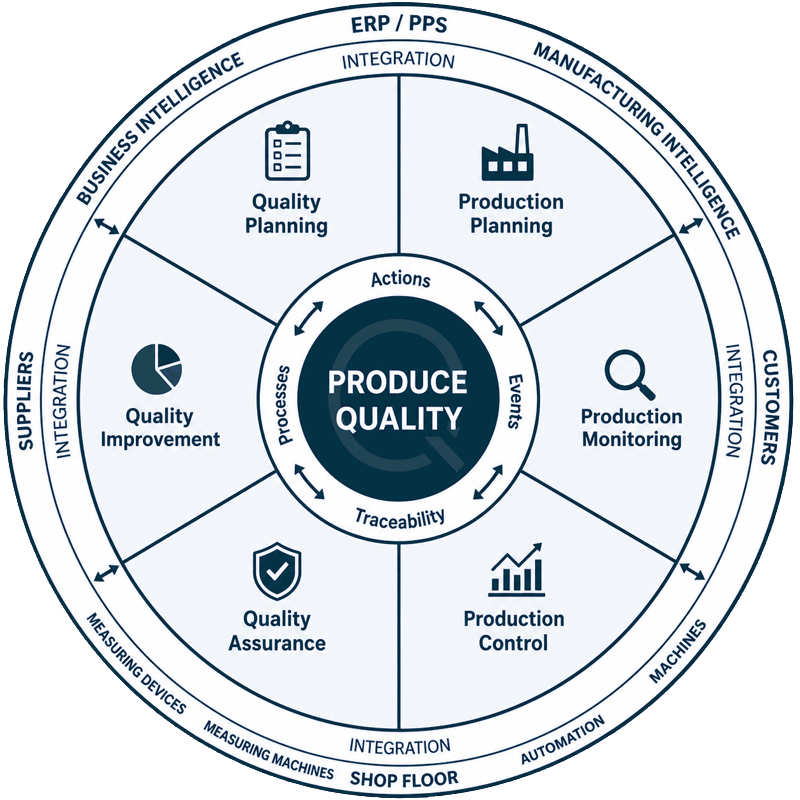
CAQ that produces quality
From inspection planning to operator guidance – modular, integrable, and SAP-compatible
- Significantly reduced inspection effort through CTQ and adaptive inspection strategies
- Zero-defect approach through inline inspection and machine integration
- End-to-end SAP integration and shopfloor connectivity
More than 45 years in manufacturing